Recommended Blog Posts
- The Ultimate CLB 9 Guide: How to Secure Your Canada PR in 2026
- Physicians with Canadian Work Experience, 2026-Version 1: The Ultimate Express Entry Guide
- Single-Entry vs. Double-Entry Visa: The Difference That Can Make or Break Your Trip
- IRCC Application Status Explained: AOR, Medical Passed, PPR, COPR
- Atlantic Immigration Program 2026: Canada PR for Skilled Workers and International Graduates
Educational Credential Assessment (ECA) - Immigration Steps for International Students
Publish On: December 05, 2025
If you’re planning to immigrate to Canada, apply for Express Entry, or pursue further education abroad, one requirement you will hear repeatedly is the Educational Credential Assessment (ECA) . For thousands of applicants each year, getting their foreign degree evaluated is the first major step toward building a new life in Canada.
But what exactly is an ECA?
- Why is it required?
- Which organization should you choose?
- How long does it take?
- And most importantly — how do you make sure your ECA does not get delayed or refused?
What Is an Educational Credential Assessment (ECA)?
An Educational Credential Assessment (ECA) is a formal evaluation that determines whether your foreign education — such as a bachelor’s degree, master’s degree, diploma, or certificate — is equivalent to a Canadian education level.
ECA tells IRCC whether your foreign degree is valid and how it compares to Canadian education standards.
It’s required because education systems vary widely across the world. The ECA ensures fairness and credibility when applicants compete under Express Entry or apply for regulated professions.
Why Is ECA Important for Canada Immigration?
If you're applying through Express Entry under the Federal Skilled Worker Program (FSWP), Canadian Experience Class (CEC), or Federal Skilled Trades Program (FSTP), an ECA is essential.
Key reasons why ECA matters:
-
Validates your education - IRCC wants to confirm your degree is legitimate and meets Canadian academic standards.
-
Impacts your CRS score - Higher education implies more Comprehensive Ranking System points.
-
Determines eligibility for Express Entry - Without an ECA, foreign education typically earns zero points.
-
Required for many Provincial Nominee Programs (PNPs) - Some provinces require ECAs even before you submit an Expression of Interest (EOI).
-
Mandatory for regulated professions - Fields like medicine, engineering, pharmacy, and teaching often require specialized ECAs.
Who Needs an ECA for Express Entry?
You need an ECA if:
- You completed your education outside Canada
- You want to claim points for your degree in Express Entry
- You’re applying under FSWP (mandatory requirement)
- You’re a principal applicant or spouse (optional but beneficial for extra points)
Even if you're applying under the Canadian Experience Class (CEC), an ECA can significantly boost your CRS score.
Types of ECAs and Which One You Need
There are two major categories:
A. ECA for Immigration (IRCC-approved)
Used for Express Entry, PNPs, and Work Permits.
B. ECA for Licensing / Professional Registration
Required for regulated occupations such as:
- Doctors
- Nurses
- Pharmacists
- Engineers
- Dentists
- Teachers
Important: The same ECA cannot always be used for both immigration and professional licensing. Some professions require assessments by specific governing bodies.
Approved ECA Organizations (2026)
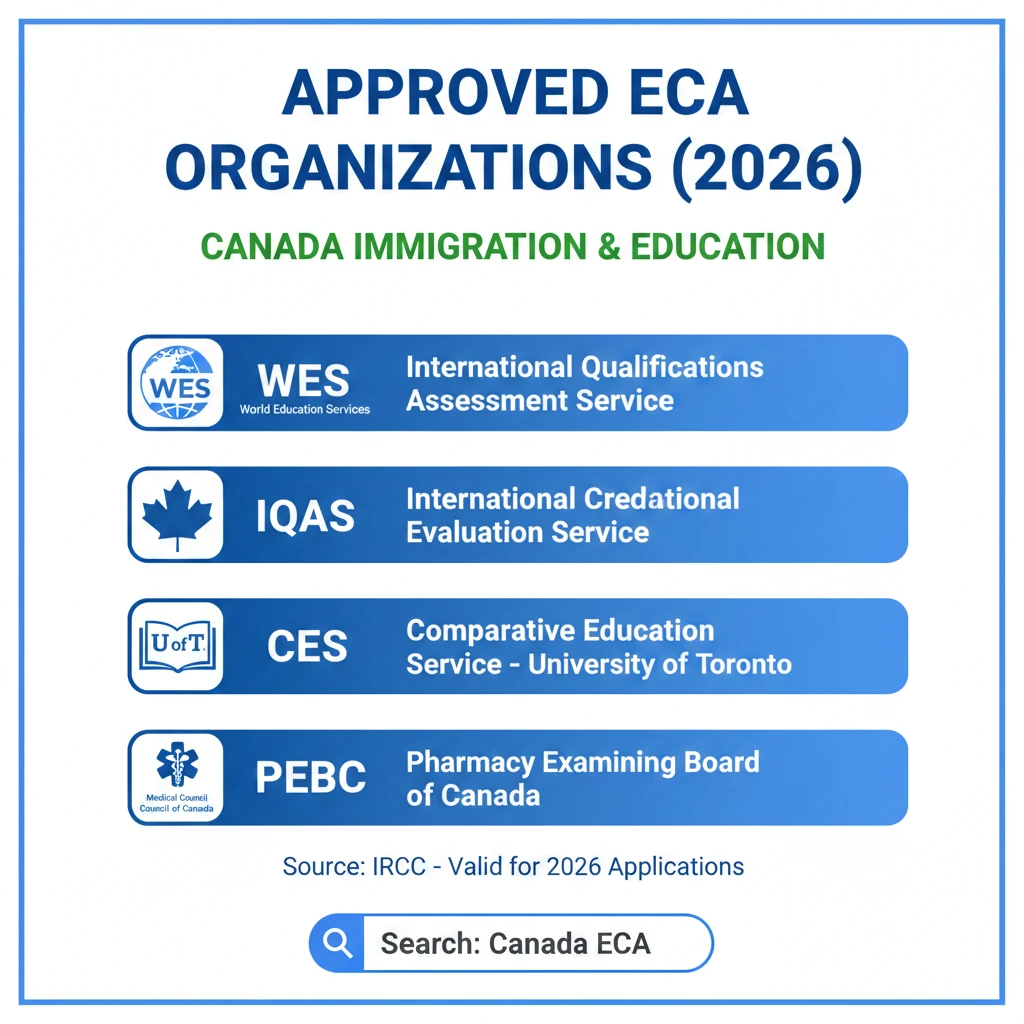
1. WES (World Education Services) Fastest for Most Applicants
- Best for bachelor’s and master’s degrees
- Digital processing
- Works directly with universities
- Processing time ~ 4–6 weeks
2. IQAS (International Qualifications Assessment Service) : Unique or Complex Credentials
- Longer wait times
- Accepts a wider variety of international documents
- Processing time ~ 12–20 weeks
3. CES (Comparative Education Service – University of Toronto) - Credibility and Detailed Assessments
- Slightly slower than WES
- Processing time ~ 12 weeks
4. PEBC (Pharmacy Examining Board of Canada) Required for pharmacists
- Assessment includes document verification
- Essential for pharmacy licensure in Canada
Step-by-Step Process to Get Your ECA
Step 1: Choose an IRCC-approved organization
Select based on your profession, document type, and processing speed.
Step 2: Create an online account
Organizations like WES walk you through every step.
Step 3: Upload academic documents
Typically includes:
- Degree certificate
- Transcripts
- Mark sheets
- Proof of name change (if applicable)
Step 4: Request your university to send official transcripts
Most ECA bodies require sealed, direct submissions.
Step 5: Pay the ECA processing fee
Ranges from $200–$350 depending on the organization.
Step 6: Wait for credential evaluation
Processing times vary: 4–20 weeks.
Step 7: Receive your ECA report
This report states your Canadian-equivalent education level.
ECA Processing Times (Updated 2026)
|
Organization |
Approx. Timeline |
|
WES |
4–6 weeks |
|
CES |
10–12 weeks |
|
ICES |
8–14 weeks |
|
IQAS |
12–20 weeks |
|
MCC |
2–4 months |
|
PEBC |
Varies by stage |
If your primary occupation is a specialist physician, surgeon, or general practitioner (NOC 31100, 31101, or 31102), you must get your ECA from the Medical Council of Canada (MCC). Delays occur if universities respond late or documents are incomplete.
How ECA Affects Your CRS Score
Your ECA determines whether IRCC recognizes your degree as:
- Secondary school equivalent
- One-year diploma
- Two-year diploma
- Bachelor’s degree
- Master’s degree
- Doctorate
Higher equivalency → higher CRS points
Example: A master's degree earns up to 135 CRS points for education alone. A spouse’s ECA adds up to 10 extra points.
Many applicants go from non-competitive to competitive simply by gaining these points.
Final Thoughts: Is ECA Worth It?
An Educational Credential Assessment is more than a mandatory document — it is the foundation of your immigration process. Without an ECA, your foreign degree holds no weight in Express Entry, and your CRS score will be significantly lower.
Whether you’re pursuing permanent residency, preparing for a professional license, or validating your academic background in Canada, starting your ECA early is one of the smartest decisions you can make. It not only boosts your points but also demonstrates your commitment and readiness to integrate into Canada’s academic and economic environment.