Recommended Blog Posts
- Canada Agriculture PR Pathways 2026: From Study Permit to Permanent Residency for Agriculture Graduates
- The Ultimate CLB 9 Guide: How to Secure Your Canada PR in 2026
- Immigration Medical Examination (IME) For Canada PR: Medical Test, Process, Validity, Cost, And Refusal Risk
- Educational Credential Assessment (ECA) - Immigration Steps for International Students
- Canada PR for Construction Managers With a Low CRS Score: Best Pathways in 2026
Biometrics for Canada PR vs. Temporary Visas: Why Your Old Data May Not Be Enough
Publish On: May 07, 2026
Navigating the Canadian immigration system in 2026 requires more than just submitting paperwork; it requires a precise understanding of identity verification. A common point of confusion is the 10-year validity rule. While this rule applies to tourists, students, and workers, it does not always apply to those transitioning to Permanent Residency.
Temporary vs. Permanent Residency (Difference)
Temporary Resident Visas (TRV)
For applicants seeking a visitor visa, study permit, or work permit, biometrics are generally valid for 10 years. If you provided fingerprints and a photo for a visitor visa in 2022, you typically do not need to provide them again for a new study permit until 2032.
Permanent Residency (PR)
The rules change significantly for PR applicants. IRCC policy states that anyone applying for permanent residence must provide their biometrics and pay the associated fee, regardless of whether they have provided them in the past for a temporary visa. This ensures that the high-stakes identity verification required for lifelong residency is up-to-date and highly secure.
Why IRCC Requires New Biometrics for PR
Even if your previous biometrics are still "valid" on the 10-year temporary scale, you must resubmit for PR for several reasons:
- Enhanced Security Screening: PR biometrics are cross-checked against more extensive national and international security databases, including the RCMP and Interpol.
- Identity Integrity: To prevent fraud, IRCC must confirm that the person applying for permanent status is the exact same individual who originally entered the country.
- Policy Alignment: As of 2026, IRCC is standardizing biometric collection across all major pathways—including citizenship—to eliminate security inconsistencies.
Biometrics Fees & Deadlines (2026 Update)
When transitioning from a temporary visa to PR, you must budget for the following:
| Category | Fee (CAD) | Timeline |
|---|---|---|
| Individual Applicant | $85.00 | Must be paid at submission. |
| Family (2+ Members) | $170.00 (Max) | All members should attend the same appointment. |
| Submission Window | N/A | 30 days from receiving your BIL. |
Pro Tip: Do not attempt to give biometrics before receiving your Biometric Instruction Letter (BIL). Using an old BIL or going without one will lead to immediate application delays.
Planning Your Biometric Appointment
To ensure your biometrics confirmation is successful:
- Avoid Temporary Decorations: Ensure any henna, tattoos, or bandages on your hands or face are cleared before your appointment to avoid a "poor quality" rejection.
- Verify Validity Online: Before paying any fees, use the official IRCC "Check Status" tool to confirm if your current biometrics are considered valid for your specific application type.
- Bring the Right Documents: You must bring a printed copy of your BIL and your valid passport to the Visa Application Centre (VAC).
As Canada stabilizes its permanent resident targets to 380,000 annually through 2028, ensuring your biometrics are handled correctly is the first step toward a smooth transition to your new home.
Below is a comprehensive checklist of documents and essential preparation steps for your 2026 Canada biometrics appointment.
Preparation & Physical Requirements
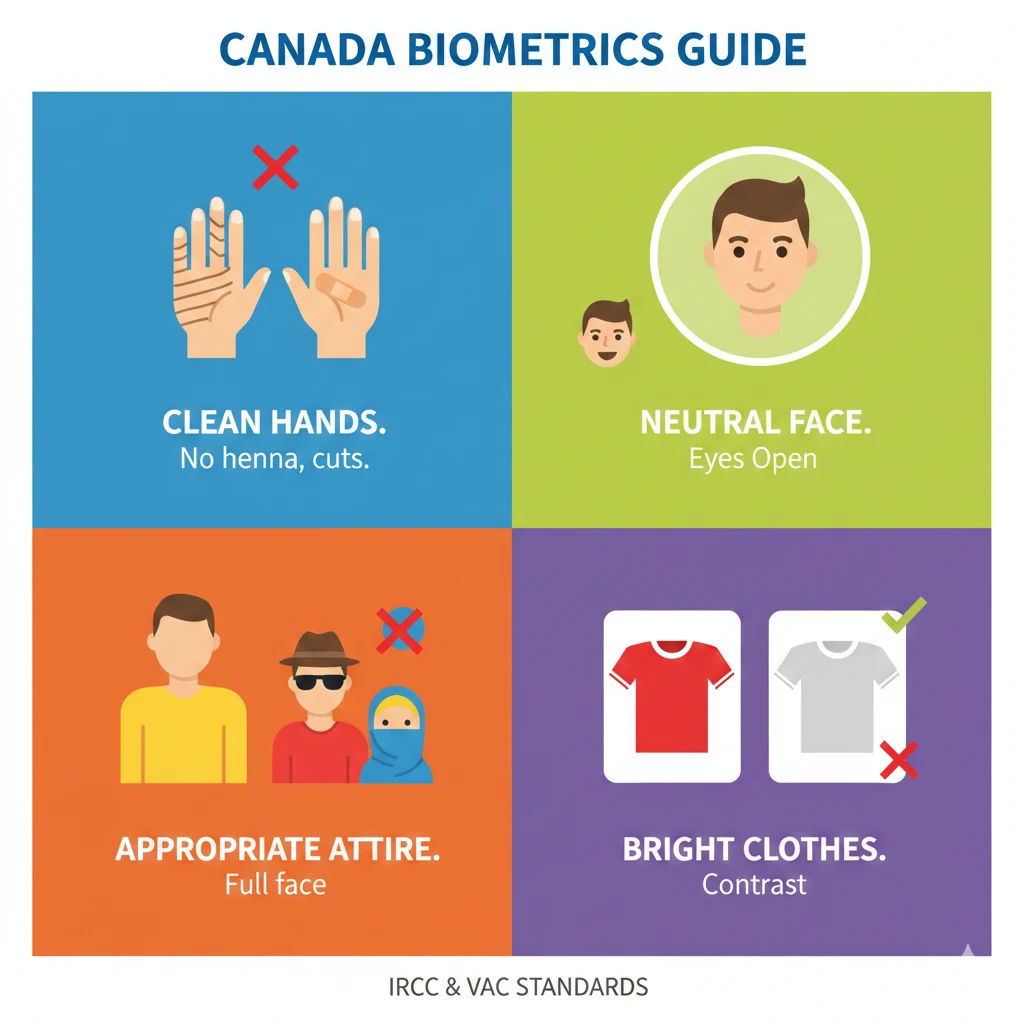
IRCC and VACs have strict standards for digital capture:
- Clean Hands: Ensure fingertips are free from henna (mehndi), cuts, or temporary injuries. Scanners may fail to capture data if hands are not clear.
- Neutral Facial Expression: For the digital photo, maintain a neutral expression with eyes open.
- Appropriate Attire: Avoid hats, tinted glasses, or head coverings unless worn for religious or medical reasons. If wearing a religious covering, your full face from forehead to chin must be visible.
- Clothing Color: Bright-colored clothing is often recommended over light colors to provide better contrast against white backgrounds.
Mandatory Documents Checklist
You must carry hard copies of these documents to your appointment:
- Biometric Instruction Letter (BIL): The official letter from IRCC with a barcode. Ensure it is for your current application; using an old BIL can lead to delays or refusal.
- Valid Original Passport: The same passport used in your visa application. It must be unexpired and in good condition.
- Appointment Confirmation Letter: The confirmation page or email you received after booking your slot at the Visa Application Centre (VAC) or Service Canada.
- VAC Consent Form: Many centers require a signed consent form for each applicant.
Recommended Supporting Documents
While not always mandatory, these can prevent issues if technical or identity verification questions arise:
- Government-Issued ID: A secondary photo ID like a driver’s license or national ID card.
- Biometrics Fee Receipt: Proof of the $85 CAD (individual) or $170 CAD (family) payment.
- Previous Biometrics Confirmation: If you have had fingerprints taken for Canada within the last 10 years for a temporary visa.
Who Does IRCC Share Your Biometrics With?
As part of processing your Canada PR application, IRCC shares your biometric data with:
- The RCMP (Royal Canadian Mounted Police): Your fingerprints are checked against records of criminals, refugee claimants, deportees, and prior temporary resident applicants.
- Canadian law enforcement agencies: To enforce federal or provincial laws, if applicable.
- Other Canadian government institutions.
- Five Eyes partner countries: Your fingerprints and photo may be shared with the USA, UK, Australia, and New Zealand — but only in ways that respect privacy laws, civil liberties, and human rights, including the Canadian Charter of Rights and Freedoms.
- Canada Border Services Agency (CBSA): Your biometrics are shared so border officers can verify your identity when you arrive in Canada.
Final Thoughts
Submitting biometrics for Canada PR is a secure, well-regulated process. Canada's government takes your privacy seriously, and multiple legal safeguards are in place to protect your data. Understanding this step can ease anxiety and help you move forward with confidence in your immigration journey.