Recommended Blog Posts
- How International Nurses and Medical Scholars Can Get Permanent Residence in Canada?
- Single-Entry vs. Double-Entry Visa: The Difference That Can Make or Break Your Trip
- IEHP Programs in Canada: Helping Foreign Doctors & Nurses Build Their Careers
- The Ultimate CLB 9 Guide: How to Secure Your Canada PR in 2026
- Canada PR for Farmers: Your Complete 2026–2027 Roadmap
LMIA vs. Category-Based Draw: The 2026 Strategy for IT Workers
Publish On: November 25, 2025
If you are a tech professional in the United States planning your move to Canada, you must be wondering for the best suitable pathway for Canada PR.
For the past two years, the strategy for IT professionals has been clear:
- Get into the Express Entry pool.
- Hope for a STEM category-based draw to get an invitation with a lower score.
- If that fails, get a Labour Market Impact Assessment (LMIA) from an employer to get 50 or 200 bonus points.
This strategy does not guarantee permanent residence for new applicants from the tech industry.
In 2025, IRCC made two "game-changing" updates that completely rewrote the rules for IT professionals. If you are still following the old advice, you are wasting your time.
#1: The 50/200-Point LMIA Bonus is Gone
For years, the "golden ticket" for many applicants was a job offer supported by an LMIA. This document, which an employer gets to prove they need to hire a foreign worker, would grant you 50 (or 200 for senior managers) "Arranged Employment" points in Express Entry.
Effective March 25, 2025, IRCC removed these bonus points entirely.
This was a temporary measure with no end date, aimed at reducing fraud and leveling the playing field.
- What this means: Your CRS score will no longer magically jump from 480 to 530 just by getting an LMIA-backed job offer. The LMIA has lost its power as a direct points booster for Express Entry.
- The New Reality: This change makes candidates without job offers more competitive in general draws and places a massive new emphasis on category-based selection.
#2: Most IT Jobs Were Removed from the STEM Category
This is the update that almost everyone missed.
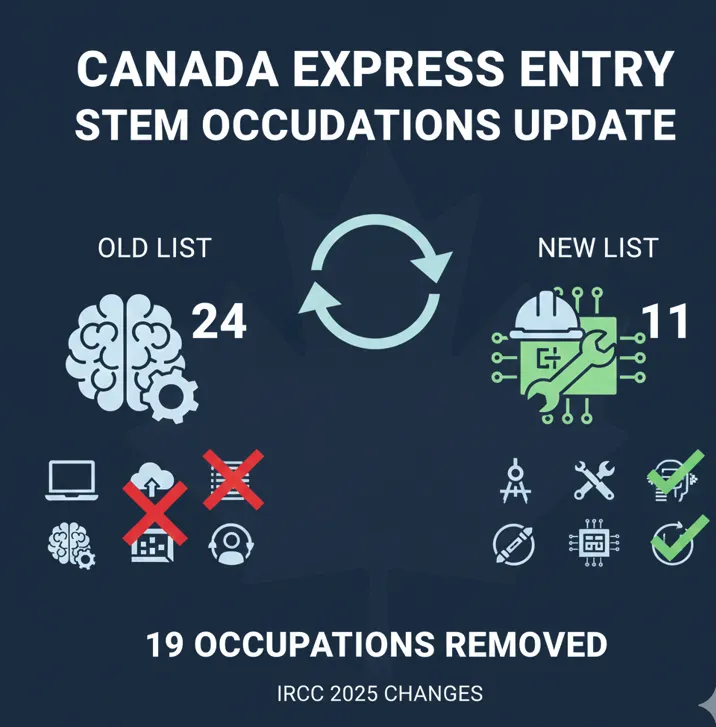
When category-based draws were announced, the STEM category was seen as the main path for IT workers. But in February 2025, IRCC published its updated category lists. In that update, 19 occupations were removed from the STEM category.
The removed list includes the most common IT roles:
- Software developers and programmers (NOC 21232)
- Software engineers and designers (NOC 21231)
- Data scientists (NOC 21211)
- Web developers and programmers (NOC 21234)
- Cybersecurity specialists (NOC 21220)
- Computer and information systems managers (NOC 20012)
- ...and many more.
The 2026 STEM category is now hyper-focused on Engineers (Civil, Mechanical, Electrical), Technologists/Technicians, and other applied sciences.
The takeaway is blunt: If you are a Software Developer, your path is no longer the STEM category draw.
So... Is the LMIA Useless? (No, Its Role Just Changed)
With no CRS points and no STEM category, you might feel like your options are gone. This isn't true. The LMIA is still one of the most powerful tools in Canadian immigration—its purpose has just shifted.
The LMIA is no longer a points tool. It is now an enabling tool.
It is the key that unlocks a Closed Work Permit. This allows you to move to Canada, start working for your employer, and pursue a different—and often more reliable—path to permanent residency.
The New 2026 Playbook: LMIA vs. Category Draw
For a U.S.-based IT professional (like a Software Engineer), the strategic comparison is no longer simple. Here is the new decision matrix for 2026.
|
Strategy |
Path 1: The LMIA "Two-Step" (Work Permit First) |
Path 2: The "Category" Draw (PR First) |
|
What is it? |
An employer gets an LMIA. You get a closed work permit, move to Canada, and work for 1-2 years. |
You stay in the Express Entry pool and wait for an invitation directly from your home country. |
|
Who is it for? |
Everyone. This is the most reliable, "brute force" method for any IT professional. |
Specialists. This path is now only for IT workers who have a second in-demand skill. |
|
The How-To |
1. Job Offer: Get a job offer from a Canadian employer. 2. LMIA: Employer applies for an LMIA (e.g., through the Global Talent Stream, which has a 10-day processing time). 3. Work Permit: You apply for a work permit (approx. 11 weeks from the U.S.). 4. Gain Experience: Work in Canada for 1-2 years. 5. Apply for PR: You now qualify for the Canadian Experience Class (CEC), which has much lower CRS score requirements. |
1. Get in the Pool: Get your ECA, take your language tests, and enter the Express Entry pool. 2. Qualify for a New Category: Since "STEM" is out, you must qualify for a different category. The main one is: • French Language Proficiency: (Get NCLC 7 in all skills). • New 2026 Categories: Potentially "Senior Managers" if you are an IT Director. 3. Get Invited: Wait for a category-based draw with a low score. French draws in 2025 went as low as 379. |
|
Pros |
• Certainty: You're in Canada and earning a salary. • Bypasses High CRS: You no longer care about the 500+ general draw. • Easier for IT: Employers can get LMIAs for tech roles more easily. • Faster Entry to Canada: You can be working in Canada in 3-4 months. |
• Direct PR: You land in Canada as a Permanent Resident. • No Employer Dependency: You are not tied to one specific employer. • Very Low CRS (If you're bilingual): French speakers have a massive advantage. |
|
Cons |
• Dependent on Employer: You are tied to the employer on your closed work permit. • Longer Path to PR: The entire process (work + PR) can take 2-3 years. • LMIA Cost: The employer pays a $1,000 application fee. |
• Highly Niche: Useless if you don't speak French or aren't a senior manager. • No Guarantee: You are just "waiting" in the pool with no certainty of an invitation. • Slower Entry to Canada: You wait in the U.S. until your PR is fully processed (6-9 months after an ITA). |
The USA Special: The CUSMA Exemption (Path 3)
If you are a U.S. Citizen (or Mexican citizen), you have a third, incredibly powerful option that blows both of the above out of the water.
You can often bypass the LMIA entirely using a CUSMA (NAFTA) work permit.
- CUSMA Professionals: If your role (like "Computer Systems Analyst") is on the CUSMA professions list, you can get a work permit with just a job offer letter. No LMIA, no 4-week advertising, no $1,000 fee.
- Intra-Company Transfer: If your U.S. company has an office in Canada, they can transfer you as a "specialized knowledge" worker or manager. This is also LMIA-exempt.
Your Strategy (as a U.S. Citizen):
- Use a CUSMA work permit to move to Canada.
- Work for one year.
- Apply for PR through the Canadian Experience Class (CEC).
This is the fastest, cheapest, and most efficient path for eligible U.S. tech professionals.
Conclusion: Which Path is Better for an IT Worker in 2026?
The Verdict: The "old" strategy is dead. The game is no longer about getting a 50-point boost or waiting for a STEM draw.
- For most IT Professionals (Developers, Data Scientists): The LMIA Two-Step(Path 1) is the new, most reliable strategy. It focuses on getting you into Canada on a work permit first, letting you bypass the high CRS scores and qualify for PR through the CEC.
- For U.S. Citizens: The CUSMA (Path 3) is by far the superior option, as it achieves the same goal as the LMIA but with almost no cost or processing time.
- For Bilingual IT Professionals: The "Category" Draw (Path 2) is your golden ticket only if you have strong French skills. If you do, this is your fastest path to direct PR.
Your U.S. tech experience is more in-demand than ever. But to succeed, you must use the 2026 playbook, not the 2024 one.