Recommended Blog Posts
- Educational Credential Assessment (ECA) - Immigration Steps for International Students
- K7 Immigration Client Success Story: Achieving Canada Work Permit and PGWP Extension
- Moving Your Medical Practice to Canada: NOC Codes 31100, 31101, and 31102 Explained
- How Your CLB Score Directly Affects Your CRS Score
- Single-Entry vs. Double-Entry Visa: The Difference That Can Make or Break Your Trip
From Study Permit to PR: How International Graduates Can Actually Make It Happen
Publish On: May 09, 2026
DFor most international graduates, the next goal is permanent residence. The good news: the path from study permit to PR is well-defined. But the rules have changed significantly in 2025–2026, and what worked two years ago may no longer apply.
What Changed in 2025–2026: Critical Updates
Before anything else, here are the key rule changes that every international graduate must know:
PGWP field-of-study restriction (effective June 25, 2025) If you're in a non-degree program (diploma, certificate), your program must now be linked to Canada's high-demand occupations to qualify for a PGWP. Bachelor's, master's, and doctoral programs are fully exempt from this requirement. As of 2026, IRCC has frozen the eligible fields list — 1,107 programs remain eligible with no additions or removals planned this year.
Study permit cap reduced for 2026 Canada is issuing up to 408,000 study permits in 2026 — a 7% drop from 2025. However, master's and doctoral students at public institutions are now exempt from the cap and don't need a PAL/TAL to apply.
International student admissions target cut nearly in half The federal government set a 2026 admissions target of 155,000 new international students — down 49% from 305,900 in 2025. This actually benefits those already here: fewer future graduates means less competition for the same PR spots down the line.
Prerequisite/pathway program students: shorter buffer period If you're in a language or foundational program before your main credential, your study permit is now valid only for the duration of the program plus 90 days. Previously, students had up to a year. Missing this window risks loss of status.
PGWP language requirements now uniform As of December 2025, IRCC harmonized PGWP language and field-of-study rules across colleges and universities. Both groups are now assessed the same way, removing earlier inconsistencies.
The Main Route: Canadian Experience Class (CEC)
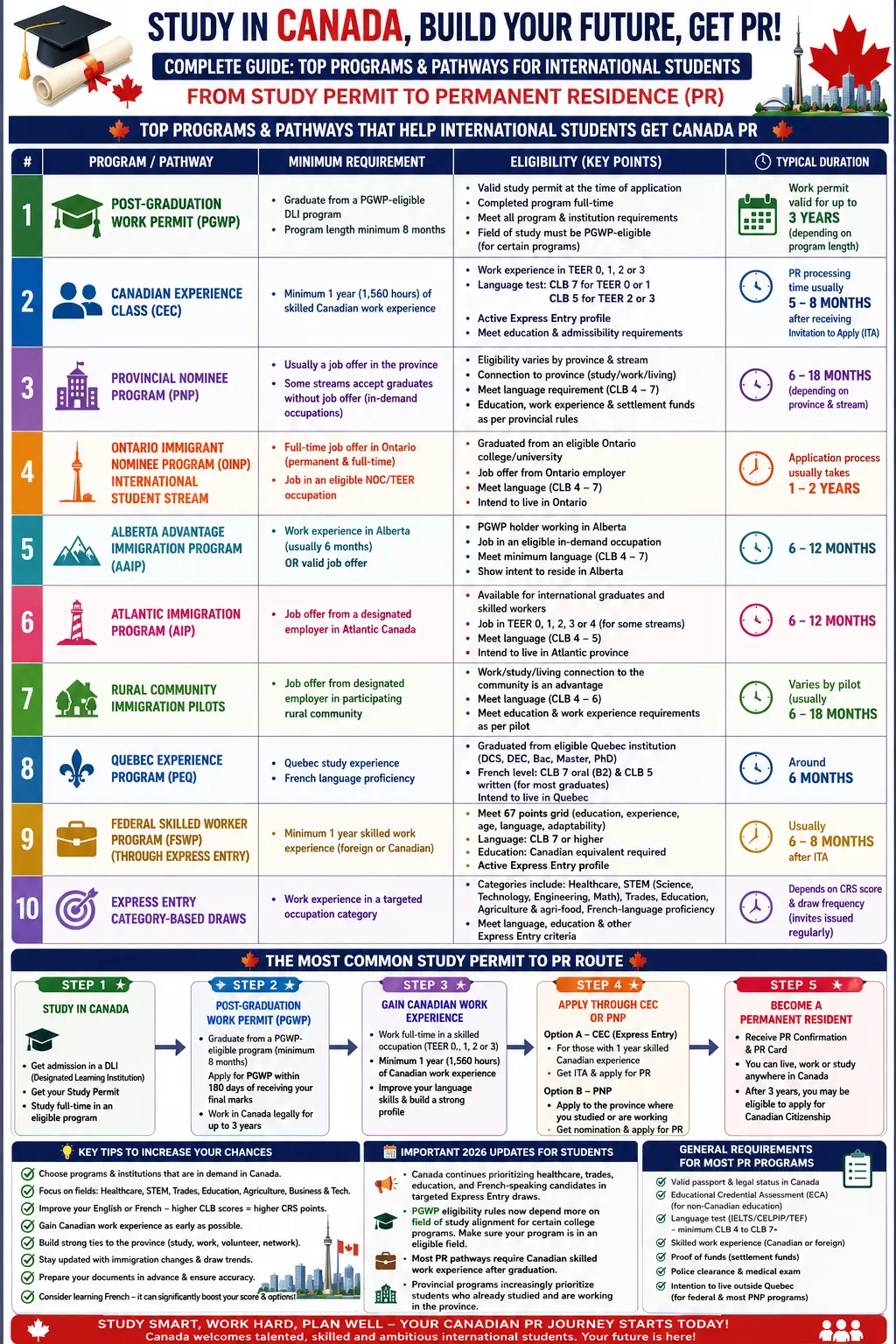
The Canadian Experience Class remains the primary federal pathway for international graduates. Here's why it suits you specifically:
- It rewards Canadian work experience — which you gain through your PGWP
- No job offer required
- Processing is typically faster than other streams (around 6 months)
- No general Express Entry draws since April 2024 — all draws are now category-based or CEC-specific, which is an advantage for PGWP holders
Step 1: Apply for Your PGWP Immediately After Graduation
Apply within 180 days of program completion. You can work full-time while waiting for a decision if you meet all conditions (valid study permit at time of application, eligible program, met language/field requirements where applicable).
PGWP length depends on your program:
- Programs of 8 months to 2 years → PGWP valid for the same length as the program
- Programs of 2 years or more → 3-year PGWP
- Master's graduates → 3-year PGWP regardless of program length (a significant advantage)
Insight: If you're choosing between a 1-year and 2-year program, the 2-year version gives you a longer PGWP and more time to build the experience needed for PR.
Step 2: Choose the Right Job
Only NOC TEER 0, 1, or 2 roles count toward CEC. TEER 3 is eligible too in some cases. Broadly:
- TEER 0: Management
- TEER 1: Professional (engineers, accountants, nurses, etc.)
- TEER 2: Technical, skilled trades
Part-time work counts if it adds up to the full-time equivalent of 12 months. Hours from multiple employers can be combined.
Keep every document: employment contracts, pay stubs, T4 slips, and reference letters. These are your proof.
Step 3: Meet the Language Requirement
Official language test scores (IELTS, CELPIP for English; TEF, TCF for French) are required. Minimum:
- TEER 0 and TEER 1: CLB 7
- TEER 2 and TEER 3: CLB 5
Even studying in English doesn't exempt you. A higher language score also meaningfully increases your CRS total — worth improving before submitting your profile.
Step 4: Create Your Express Entry Profile
Once you have 12 months of qualifying Canadian work experience and a valid language score, create your Express Entry profile. Your CRS score is calculated from:
- Age
- Education level
- Canadian work experience
- Language proficiency
- French ability (bonus points — significant advantage in 2026 with increased French-language draws)
- Adaptability factors
If you receive an Invitation to Apply (ITA), submit your complete PR application. Processing time: approximately 6 months.
Provincial Nominee Programs (PNPs) for International Graduates
PNPs are a strong alternative — or complement — to the federal CEC route. A provincial nomination adds 600 CRS points, which virtually guarantees an ITA if you're in Express Entry. Several provinces have streams built specifically for international graduates.
Here's a province-by-province breakdown with current status:
Ontario — OINP (Three Streams)
1. Employer Job Offer: International Student Stream
- Requires a full-time, permanent job offer from an Ontario employer (NOC TEER 0, 1, 2, or 3)
- No prior work experience required — suitable for recent graduates entering the workforce
- Important 2025 change: as of July 2, 2025, employers must now initiate the process through the OINP Employer Portal before the candidate can register an EOI
- Must have completed a 2-year diploma or degree from a publicly-funded Ontario college or university
2. Masters Graduate Stream
- For international graduates of Ontario master's programs
- No job offer required
- Uses a points-based EOI system; invitations issued periodically by draw
- Must have completed at least one full academic year of full-time study
3. PhD Graduate Stream
- Same structure as the Masters stream
- Open for limited intakes with a fixed number of slots
- No job offer required
Insight: The Masters and PhD streams are among the most graduate-friendly in Canada — no job offer, no work experience required. If you're completing a graduate degree in Ontario, these should be your first consideration.
Saskatchewan — SINP (Students Stream)
Saskatchewan's program is one of the more accessible options for graduates who studied or worked in the province.
Key requirements:
- Graduated from a recognized Saskatchewan post-secondary institution
- Minimum 6 months (780 hours) of paid work experience in Saskatchewan related to your field of study
- A permanent, full-time job offer in Saskatchewan (NOC TEER 0, 1, 2, or 3, or a designated trade)
- Valid PGWP at time of application
- Employer must register with SINP and obtain a Job Approval Letter
Graduates from other provinces can also apply if they have the required Saskatchewan work experience, but the education criteria differ slightly.
Fee note: As of April 1, 2026, a $500 application fee applies to all worker categories including students.
Insight: Saskatchewan accepts applications on an ongoing basis (no intake windows for most streams), making it one of the more accessible programs timing-wise.
Manitoba — MPNP International Education Stream (IES)
Manitoba's IES is designed exclusively for graduates of Manitoba institutions. Three distinct pathways:
Career Employment Pathway
- Must have a full-time, long-term job offer in an in-demand occupation aligned with your field of study
- Job must be located in Manitoba
- Strong employability and genuine intention to stay in Manitoba required
Graduate Internship Pathway
- For master's and PhD graduates who completed a recognized internship or fellowship
- No job offer required
- Minimum CLB 7 language requirement
- Must attend a mandatory information session before submitting an EOI
International Student Entrepreneur Pilot (ISEP)
- Limited to 20 graduates per year
- For those who want to establish a business in Manitoba instead of traditional employment
- Must operate the business for at least 12 months and meet performance targets before nomination
- Mandatory information session required
Insight: If you're a master's grad with an internship background and want to avoid the job-offer requirement, Manitoba's Graduate Internship Pathway is one of the few no-job-offer options outside Ontario.
British Columbia — BC PNP (Currently Paused)
BC previously had two dedicated international graduate streams (International Graduate and International Post-Graduate). Both were discontinued in late 2024. BC announced replacement streams (Bachelor's, Master's, Doctorate) planned for 2025, but these remain suspended due to provincial allocation issues.
Current status: Graduates interested in BC should monitor BC PNP announcements closely. The streams are not accepting applications as of mid-2026. Graduates in BC can still pursue CEC federally.
Alberta — AAIP
Alberta does not have a dedicated international graduate stream, but graduates can access the Alberta Advantage Immigration Program (AAIP) through:
- Alberta Opportunity Stream — for workers already living and working in Alberta on a valid work permit (including PGWP holders) with a job offer
- Dedicated Healthcare Pathway — targeted at healthcare workers, including recent graduates in nursing and allied health fields
Alberta is actively recruiting through its "Alberta is Calling" initiative, and the healthcare and trades pathways have strong demand. The latest Alberta PNP draw issued invitations to healthcare and social services occupations, including NOC 31102, NOC 31301, and NOC 41300.
Atlantic Provinces — Atlantic Immigration Program (AIP)
The Atlantic Immigration Program is a federal-provincial program covering New Brunswick, Nova Scotia, Prince Edward Island, and Newfoundland & Labrador. While not exclusive to graduates, it's accessible to PGWP holders with:
- A job offer from a designated Atlantic employer
- A minimum of 1,560 hours of work experience (in the last 5 years) in a NOC TEER 0, 1, 2, or 3 role, or a secondary school diploma or higher
International graduates who studied in Atlantic Canada are well-positioned given existing ties to the region.
Which Route Is Right for You?
| Your Situation | Best Route |
|---|---|
| Master's or PhD graduate in Ontario | OINP Masters/PhD Graduate Stream (no job offer needed) |
| Graduated from a Saskatchewan school with 6+ months of local work | SINP Students Stream |
| Master's grad in Manitoba with internship experience | MPNP Graduate Internship Pathway |
| Graduated anywhere in Canada, building work experience | Canadian Experience Class via Express Entry |
| Working in healthcare or trades in Alberta | AAIP Dedicated Healthcare/Opportunity Stream |
| Working in Atlantic Canada with a job offer | Atlantic Immigration Program |
| French speaker (or learning French) | French-language Express Entry draws — significant advantage |
Conclusion
For international graduates, Canada PR is no longer based on just completing a study program. Most pathways now prioritize candidates who gain Canadian work experience, secure a skilled job offer, improve language scores, or build strong provincial ties after graduation. Programs like CEC, OINP, SINP, MPNP, and AAIP each offer different advantages depending on where you study, work, and settle. Graduates who plan early, choose in-demand occupations, and gain local work experience often have a much stronger chance of transitioning from a study permit to permanent residence in Canada.