Recommended Blog Posts
- Study Agriculture and Crop Research in Canada: Admission Process, Eligibility, and Scholarships for International Students
- What Are the PGWP Updates for 2026 and How Do They Affect Your Application?
- Top Mistakes Students Make When Applying For a Canada Study Permit in 2026
- Why Study Visa Applications Get Refused and What You Can Do to Avoid Rejection
- Study Permit Proof of Funds: GIC vs. 6-Month Bank Statements—Which Is Safer In 2026?
How to Convert a Visitor Visa to a Study Permit Without Leaving Canada (2026 Guide)
Publish On: December 17, 2025
As per IRCC rules in 2025-26, visitors may apply for a study permit from inside Canada only if they meet specific eligibility conditions—such as completing a short-term course (up to 6 months), being a minor studying at the primary or secondary level, or being the spouse or dependent of a valid study or work permit holder. In most other cases, visitors must leave Canada and apply from outside the country. Studying without an approved study permit is not allowed, and applications are closely assessed for genuine study intent, financial capacity, and compliance with Canadian immigration laws.
With Canada's new policies encouraging domestic transitions and clearer rules for "inside Canada eligibility," converting a visitor visa into a study permit has become one of the most reliable pathways for 2026.
Visitor Visa to Study Permit: Is It Possible in Canada?
YES — you can apply for a study permit from inside Canada while on a visitor visa, If you meet IRCC's inside-Canada eligibility requirements.
IRCC allows certain groups of visitors to apply for a study permit inside Canada. As of 2026, here's what IRCC officially permits:
|
Eligible to apply for a study permit inside Canada:
|
Not eligible to apply inside Canada:
|
Eligibility Requirements for Switching from Visitor Status to a Study Permit
Before submitting your in-Canada study permit application, ensure you qualify for IRCC's 2026 rules.
1. Valid Legal Status in Canada
You must hold valid visitor status on the day you apply.
This means:
- Your visitor stamp or visitor record must not be expired.
- If you previously had a study or work permit, you should restore your status if it expired.
If your status is expiring soon:
You can first apply for a visitor record extension, then submit your study permit application.
2. A Letter of Acceptance (LOA) From a DLI
The LOA must be:
- From a designated learning institution (DLI)
- Issued for a program eligible for a Study Permit
- Valid for the intake you intend to start
- Matching your academic background and career plan
- For 2025–2026, many provinces may also require a Provincial Attestation Letter (PAL)
3. Sufficient Financial Proof (2026 Rules)
IRCC updated financial requirements in 2024–2026.
You must show:
- Tuition fee for 1 year
- Cost of living requirement
- Travel + settlement funds
- GIC (if applying for SDS from inside Canada — optional)
For 2026, average funds needed (non-SDS):
- Single applicant: CAD $20,000+ living cost
- First-year tuition: $14,000 – $22,000 depending on province
- Travel funds: $2,000 – $3,000
- Proof of stable, legitimate source of funds
4. Strong Purpose of Study (SOP / Study Plan Required)
Inside-Canada SOP applications require a clear explanation of:
- Why you want to study
- Why the program fits your career
- How studying in Canada will benefit your future
- Why you are applying from inside Canada
- How you will fund your studies
- Why your home ties remain strong
5. Clean Travel & Immigration History
Although not mandatory, the following strengthen your case:
- No overstays
- No previous refusals (or proper explanation if you have one)
- Genuine travel intention
6. Admission Requirements Completed
Colleges may require:
- English test (Duolingo/IELTS/TOEFL)
- Academic documents
- Fees for seat confirmation
- Prerequisite courses if needed
Once you fulfill these, you are ready to switch from visitor to student.
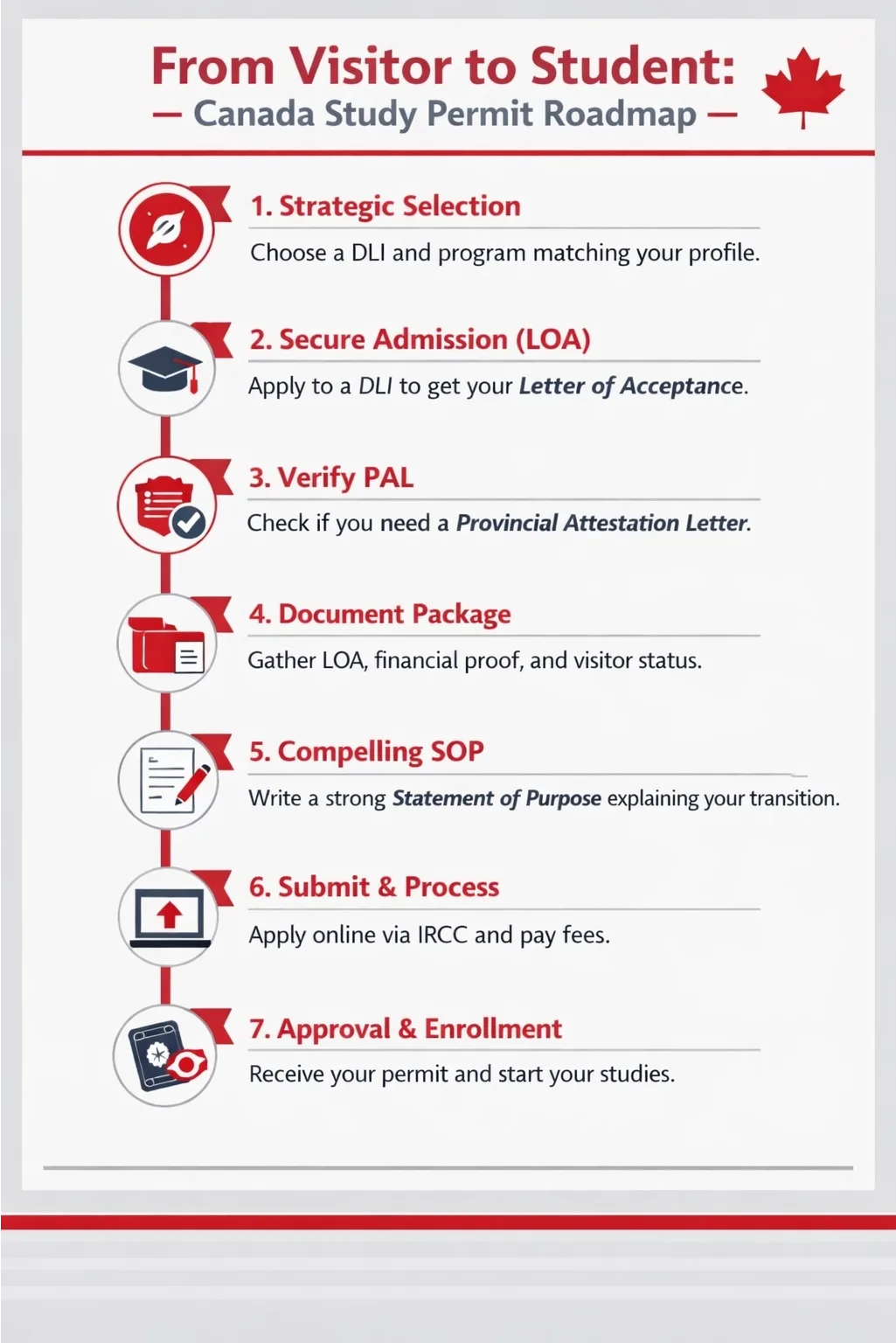
From Visitor to Student: Study Permit Steps in Canada
This is the most important part — and the entire process needs to be done carefully.
Required Documents for Converting Visitor Visa to Study Permit
Here's a complete checklist for 2026.
Personal Documents
- Passport (all pages)
- Digital photo
- Visitor visa/entry stamp
- Visitor record (if extended)
Academic Documents
- 10th/12th mark sheets
- Degree/diploma certificates
- Transcripts
- Medium of Instruction (if applicable)
- English test scores (IELTS/TOEFL/Duolingo)
Financial Documents
You must show strong financial proof:
- Bank statements (last 6 months)
- Savings account with sufficient balance
- Sponsor's financial documents (if sponsored)
- Bank statements
- Income proof
- Employment letter
- Tax returns
- GIC (optional but helpful)
- Tuition payment receipt (strongly recommended)
Immigration Documents
- Previous visa decisions (if refused before)
- Travel history
- Biometrics receipt
- Upfront medical (if needed)
Other Supporting Documents
- SOP (Study Plan)
- Resume/CV
- Work experience letters
- Ties to home country
- Family documents (if dependents)
Final Thoughts: How Visitors Can Successfully Start Their Study Journey in Canada
Converting a visitor visa into a study permit is now one of the most realistic and efficient pathways for international learners in 2026. With stricter intake caps globally and more selective visa decisions outside Canada, many applicants find it easier to secure approval from within the country.
Your success depends on:
- Choosing the right DLI and program
- Preparing a strong financial package
- Submitting a clear, human-crafted SOP
- Following IRCC rules carefully
- Maintaining legal status inside Canada
With proper planning, thousands of visitors have already turned their Canadian visit into a successful academic and career journey — and you can too.