Recommended Blog Posts
- Avoid CEC Refusal: 13 Mistakes That Can Put Your Canada PR Application At Risk
- Canadian Experience Class CRS Score Trends 2025-26: What’s a Good Score?
- Can a TEER 2 Trade Worker Apply for CEC? Canada PR Requirements Explained
- Step-by-Step Guide: How to Apply for Canada PR Through the Canadian Experience Class (CEC) in 2026
- Latest Canadian Experience Class Draw 2026: CRS Score, ITAs And CEC Updates
2026 CEC Draw Predictions: Expert Insights on IRCC’s Immigration Levels Plan
Publish On: November 10, 2025
Canadian Experience Class (CEC) draw predictions are one of the most misunderstood topics among in-Canada Express Entry candidates. Many applicants search for exact draw dates or guaranteed CRS cut-offs—but the reality is that Immigration, Refugees and Citizenship Canada (IRCC) does not pre-announce any Express Entry draws.
What can be predicted is readiness, risk level, and strategic positioning—using official rules, historical behavior, and pool mechanics. This article explains how CEC draws actually work, what influences CRS movement, and what an immigration professional must communicate clearly to applicants asking for “predictions.”
Understanding The Canadian Experience Class (CEC)
The Canadian Experience Class is designed for temporary residents with skilled Canadian work experience who are already integrated into the labour market. It operates within the Express Entry system and follows the same ranking process using the Comprehensive Ranking System (CRS).
CEC is not a standalone program with fixed draws. Instead, IRCC decides:
- whether to run a CEC-specific draw,
- include CEC candidates in general draws, or
- prioritize category-based selection instead.
This flexibility is why draw frequency and CRS cut-offs fluctuate.
First Rule Of CEC Draw Predictions: No Guarantees
Any discussion about future CEC draws must begin with a clear disclaimer:
- IRCC does not publish future draw dates
- CRS cut-offs are decided at the time of the draw
- Draw size and program type are determined internally by IRCC
CEC Eligibility Factors That Affect Draw Outcomes
Before predicting anything, an applicant must first be eligible for CEC. Many candidates asking about draw predictions fail at this basic stage.
Core Eligibility Requirements (Official Rules)
| Requirement | IRCC Standard |
|---|---|
| Eligible Work Category | TEER 0, 1, 2, or 3 only |
| Work Location | Inside Canada |
| Work Type | Paid employment only |
| Minimum Experience | 1,560 hours (12 months equivalent) |
| Timeframe | Last 3 years |
| Authorization | Must have legal work status |
| Language Level | CLB 7 (TEER 0/1), CLB 5 (TEER 2/3) |
If even one of these conditions is not met, CEC draw predictions are irrelevant for that applicant.
Does NOC Or TEER Change CEC Draw Rules?
CEC rules do not change based on occupation, but TEER level matters in two ways:
- Eligibility
- Only TEER 0–3 experience qualifies
- TEER 4 and 5 roles are excluded from CEC entirely
- Language Threshold
- TEER 0/1 → CLB 7
- TEER 2/3 → CLB 5
This is why two candidates with the same CRS may face different risks depending on TEER and language compliance.
How IRCC Decides When To Run CEC Draws
IRCC follows a round-based invitation system. For each round, it decides:
- The type of draw (CEC, general, PNP, category-based)
- The number of invitations
- The minimum CRS score
- A tie-breaking timestamp
These decisions are influenced by:
- Annual immigration targets
- Program balance (CEC vs PNP vs categories)
- Processing capacity
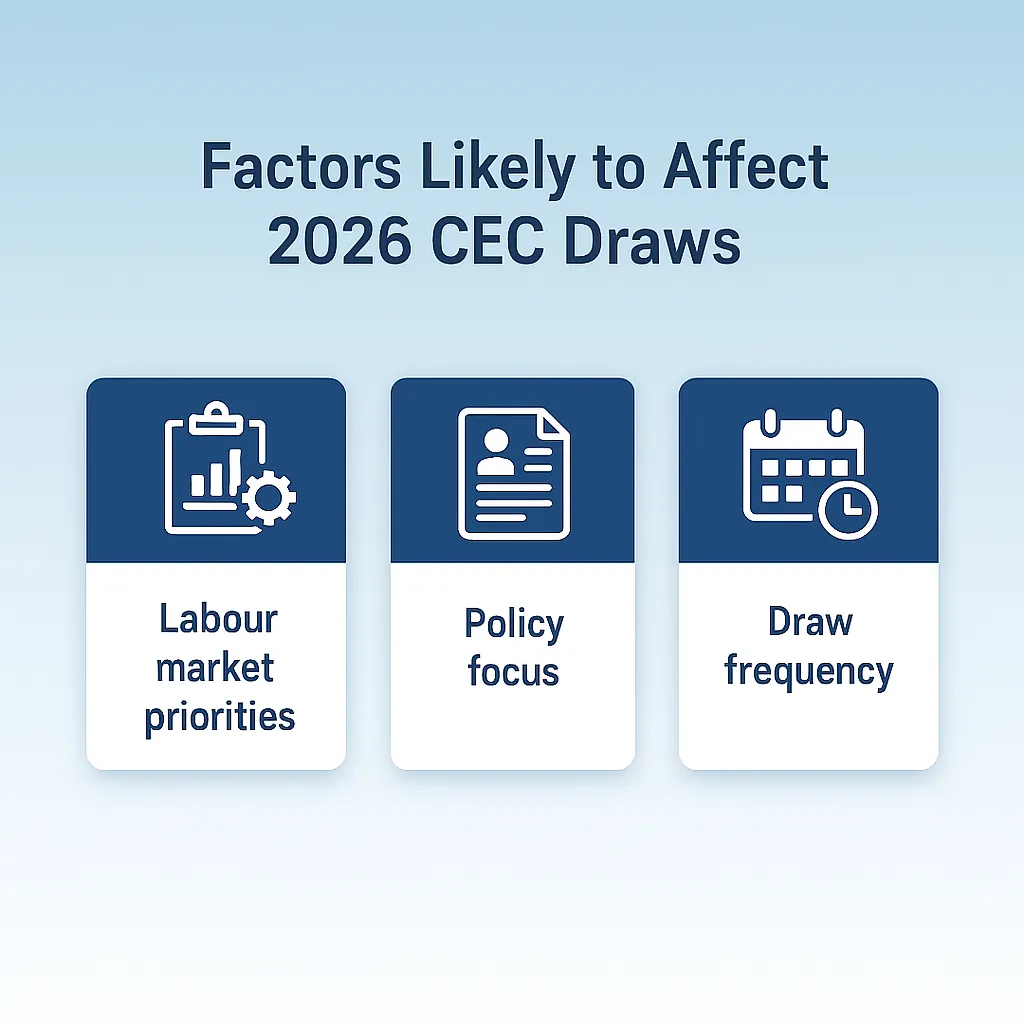
- Labour market priorities
Because these inputs change, draw patterns are adaptive, not fixed.
Why CRS Cut-Offs Move In CEC Draws
CRS scores do not rise or fall randomly. They respond to supply and demand inside the Express Entry pool.
Key Drivers Of CRS Movement
| Factor | Impact On CRS |
|---|---|
| Higher ITA volume | CRS tends to drop |
| Smaller draw sizes | CRS tends to rise |
| Category-based draws | Reduce competition in some CRS bands |
| Graduation & PGWP cycles | Increase mid-range CRS candidates |
| Profile expiry & aging | Can lower pool pressure |
This is why predictions should focus on trends, not numbers.
CEC Draw Prediction Under Canada’s 2026 Immigration Plan
Under Canada’s 2026–2028 Immigration Levels Plan, economic immigration continues to remain the government’s top priority, with a large share of permanent residence spaces allocated to skilled workers already in Canada. This policy direction strongly supports the Canadian Experience Class (CEC), as it targets candidates with Canadian work experience, language ability, and labour market integration.
While IRCC does not announce future Express Entry draw dates or CRS cut-offs, the 2026 plan suggests continued reliance on in-Canada applicants to meet permanent resident targets. As a result, CEC candidates are expected to remain competitive through CEC-specific draws, general draws, or category-based selections, depending on labour market needs and processing capacity.
Category-Based Selection And Its Effect On CEC Candidates
IRCC now regularly conducts category-based draws targeting specific profiles such as:
- French-language proficiency
- Healthcare occupations
- STEM roles
- Skilled trades
- Education-related occupations
Applicants should understand that category draws don’t replace CEC, but they reorder priorities.
What An Immigration Expert Should Collect Before Predicting Anything
Professional advice requires data. Before discussing CEC draw chances, collect:
| Applicant Detail | Why It Matters |
|---|---|
| Exact NOC + duties | Confirms correct classification |
| TEER level | Determines eligibility + language |
| Weekly hours & dates | Confirms 1,560-hour rule |
| Work permit type | Confirms authorized work |
| Language test scores | CRS + eligibility |
| Current CRS breakdown | Identifies improvement scope |
| Spouse profile | Major CRS variable |
| Proof documents | Reduces refusal risk |
IRCC does not announce CEC draw dates or CRS cut-offs in advance. What we can do is evaluate your eligibility, assess your CRS competitiveness based on recent trends, and build a strategy that improves your chances—regardless of when the next draw happens.
Conclusion
While IRCC does not guarantee future CEC draw dates or CRS cut-offs, the 2026 Immigration Levels Plan provides a solid policy context that supports continued strong CEC activity throughout the year. Applicants should remain agile, track draw results regularly, and build profile strength to maximize their chances of receiving an ITA under the ongoing immigration strategy.