Recommended Blog Posts
- Language Test Requirements for CEC Applicants: IELTS vs. CELPIP & CLB Explained
- CEC vs Federal Skilled Worker Program: Which Express Entry Path Should You Take For 2026?
- Canadian Experience Class In 2026: A Strong PR Route For Workers In Canada
- 2026 CEC Draw Predictions: Expert Insights on IRCC’s Immigration Levels Plan
- Can a TEER 2 Trade Worker Apply for CEC? Canada PR Requirements Explained
Canadian Experience Class CRS Score Trends 2025-26: What’s a Good Score?
Publish On: November 29, 2025
The Canadian Experience Class (CEC) pathway under Express Entry has seen dramatic changes in early 2026. If you're wondering what constitutes a "good" CRS score for CEC, this comprehensive guide provides the most current data, historical trends, and expert analysis to help you assess your chances of receiving an Invitation to Apply (ITA).
Understanding CEC and CRS Scores
The Canadian Experience Class is a federal immigration program under Express Entry designed for skilled workers with Canadian work experience. Your Comprehensive Ranking System (CRS) score determines your ranking in the Express Entry pool, with higher scores receiving ITAs first during draws.
Key CEC Eligibility Requirements:
- At least 12 months (1,560 hours) of skilled Canadian work experience in NOC TEER 0, 1, 2, or 3 within the last 3 years.
- Work experience gained while authorized to work in Canada under temporary resident status.
- CLB 7 for NOC TEER 0 or 1 jobs; CLB 5 for NOC TEER 2 or 3 jobs.
- Intent to live outside Quebec.
What Is Considered a Good CRS Score for CEC in 2026?
Based on the most recent canadian expereince class draw data from January 2026, here's the updated assessment:
| CRS Score Range | Assessment | Likelihood of ITA |
|---|---|---|
| 520+ | Excellent | Very High - Competitive across all recent draws |
| 510-519 | Very Good | High - Within recent CEC draw range |
| 500-509 | Good | Moderate to High - Close to recent cutoffs |
| 490-499 | Fair | Low to Moderate - Below recent thresholds |
| Below 490 | Poor | Very Low - Requires significant improvement |
Latest CEC Draw CRS Score Requirements (January 2026)
The most recent data shows IRCC conducted major CEC draws in January 2026:
| Draw Date | CRS Cutoff | Candidates Invited | Draw Type |
|---|---|---|---|
| January 21, 2026 | 509 | 6,000 | Canadian Experience Class |
| January 7, 2026 | 511 | 8,000 | Canadian Experience Class |
| December 16, 2025 | 515 | 5,000 | Canadian Experience Class |
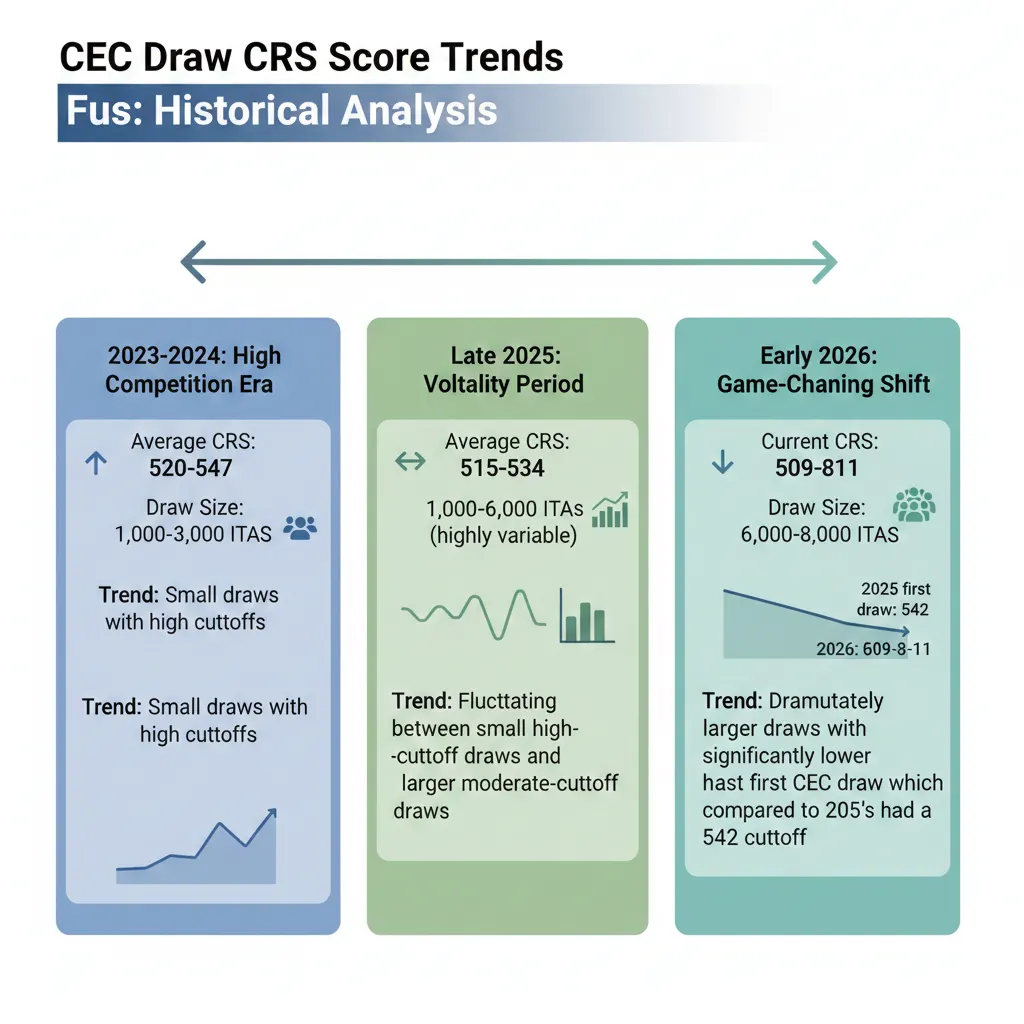
| November 2025 | 518-534 | 1,000-6,000 | Canadian Experience Class |
Critical Update: The January 7, 2026 draw was the second-largest CEC draw in Express Entry history with 8,000 invitations, surpassed only by a February 2021 pandemic-era draw that issued 27,332 ITAs.
Major 2026 Trend: Declining CRS Scores
Within the first month of 2026, IRCC issued 14,000 ITAs to CEC candidates through two large Express Entry draws, featuring some of the lowest CRS scores the program has seen in recent memory.
The January 7 draw featured a CRS cutoff lower than any Express Entry draw in 2025, with the previous lowest being 509 in September 2024.
Why the Dramatic Drop?
- Large Draw Volumes: When IRCC invites many candidates at once, it reaches deeper into the pool, helping bring CRS cutoffs down.
- Government Policy: Canada has allocated 33,000 PR spaces for in-Canada applicants across 2026-2027.
- Strategic Focus: IRCC is focusing exclusively on immigration candidates within the country, particularly those with Canadian work experience.
Minimum vs. Safe CRS Scores for CEC
Minimum CRS Score: The current minimum in January 2026 is 509—the lowest since September 2024.
Safe CRS Score: Based on current trends, 515-520 is now considered "safe," a significant decrease from the 535-540 that was recommended in late 2025.
CEC vs. Other Express Entry Pathways: CRS Score Comparison
| Draw Type | Typical CRS Range (2026) | Best For |
|---|---|---|
| CEC Category Draw | 509-520 | Canadian work experience holders |
| French Language | 379-480 | French speakers (CLB 7+ in French) |
| PNP Draw | 700+ | Provincial nominees (+600 points) |
| Healthcare/Trades/STEM | 445-505 | Category-specific occupations |
Is CEC Easier Than All-Program Draws?
Yes, significantly. General all-program draws typically require 480-540+ CRS scores, making CEC draws 30-70 points more accessible for candidates with Canadian experience.
Realistic Assessment: Your Chances by CRS Score
|
CRS 509-515:
|
CRS 515-525:
|
|
CRS 490-509:
|
CRS Below 490:
|
Final Recommendations by CRS Range
- If your CRS is 515+: You're in excellent position. Ensure your profile is complete and documents are ready.
- If your CRS is 509-515: You're currently competitive. Monitor draws closely and maintain eligibility.
- If your CRS is 490-509: You're close but below the current threshold. Focus on quick wins like language improvement.
- If your CRS is below 490: Significant improvement needed. Consider multiple strategies including French language, PNP pathways, or additional work experience.
Conclusion
Major Update: The landscape for CEC candidates has dramatically improved in early 2026. The January 7 draw's 8,000 invitations with a 511 CRS cutoff represents a significant shift from 2025, when the first CEC draw required 542 points.
A good CRS score for CEC in 2026 is now 510-520, significantly lower than the 535-550 range seen in late 2025. The current minimum cutoff of 509 is the lowest since September 2024, offering renewed hope to candidates who were previously just below the threshold.
Key Takeaway: If IRCC continues with large-volume CEC draws as seen in January 2026, we may see CRS scores stabilize or even drop into the 500-515 range throughout the year. However, candidates should not delay profile improvements, as draw patterns can change based on government priorities and pool composition.
Stay Informed: Monitor the official IRCC Express Entry rounds page for the latest draw results. With the right CRS score and strategic planning, your goal of Canadian permanent residence through CEC is more achievable in 2026 than it was in 2025.
Note: This article is based on official IRCC data and verified news sources as of January 22, 2026. CRS cutoffs and draw patterns can change. Always check the official Government of Canada immigration website for the most current information.