Recommended Blog Posts
- K7 Immigration Client Success Story: Achieving Canada Work Permit and PGWP Extension
- Canada PR for Farmers: Your Complete 2026–2027 Roadmap
- Express Entry Vs PNP for Physicians in Canada: Which PR Pathway Is Better in 2026?
- English vs French for Canada PR: Which Language Strategy Works Better in 2026?
- Educational Credential Assessment (ECA) - Immigration Steps for International Students
Canada Agriculture PR Pathways 2026: From Study Permit to Permanent Residency for Agriculture Graduates
Publish On: November 21, 2025
When people think of Canada’s strongest industries, technology and healthcare often come to mind. Yet one sector quietly driving the nation’s economic stability — and shaping its immigration priorities — is agriculture. From the rolling wheat fields of Saskatchewan to Ontario’s agri-tech hubs and Alberta’s vast ranchlands, agriculture is not just about food production; it’s about sustaining livelihoods, creating innovation, and fueling rural growth.
For students and professionals passionate about farming, crop science, or food technology, Canada has made one thing very clear: your skills are wanted, your contribution is valued, and your pathway to permanent residency (PR) has never been more defined.
Why Canada Is Prioritizing Agriculture Talent
Agriculture contributes over $140 billion annually to Canada’s GDP, and the demand for skilled professionals far exceeds domestic supply. A growing number of farmers are nearing retirement, while modern farming requires expertise in areas like biotechnology, precision agriculture, and environmental management — skills international graduates bring to the table.
To sustain the industry’s future, the government isn’t just hiring workers; it’s inviting educated agricultural professionals to stay permanently. Whether you’ve studied crop research, food processing, agronomy, or farm business management, your education aligns perfectly with IRCC’s goals: building a sustainable and innovative agri-food economy.
What makes agriculture especially appealing is that it connects directly to Canada’s rural revitalization agenda. Many smaller communities rely on international graduates to fill essential roles, and several provinces have introduced streamlined PR programs to retain talent in these regions.
From Student to Worker: The PGWP Bridge
Once you’ve completed an agriculture program at a Designated Learning Institution (DLI) in Canada, your journey toward PR typically begins with the Post-Graduation Work Permit (PGWP). This permit allows you to work anywhere in Canada for up to three years — the perfect window to build relevant experience.
For agriculture graduates, this stage is vital. The Canadian Experience Class (CEC) and the Agri-Food Pilot both reward Canadian work experience. During your PGWP, every hour you spend in a greenhouse, food lab, or research field adds value toward your future PR application.
Employers in agriculture also tend to favor candidates who studied in Canada because they’re already familiar with local standards and environmental regulations. Many rural employers actively support PGWP holders by offering full-time contracts or provincial nomination support once they prove their reliability.
Building PR Eligibility Through Work Experience
To qualify for PR under the Canadian Experience Class, you need at least one year of full-time work in a skilled role (TEER 0–3) within the past three years. That experience, paired with your education and language proficiency, builds a strong Express Entry profile.
If you choose to apply through the Agri-Food Pilot Program, the requirements are slightly different but equally achievable. You’ll need:
- One year of full-time, non-seasonal work in an eligible agriculture or food processing occupation.
- A valid job offer from a Canadian employer in an eligible industry.
- Proof of settlement funds and intent to live outside Quebec.
Understanding Occupations and NOC Codes
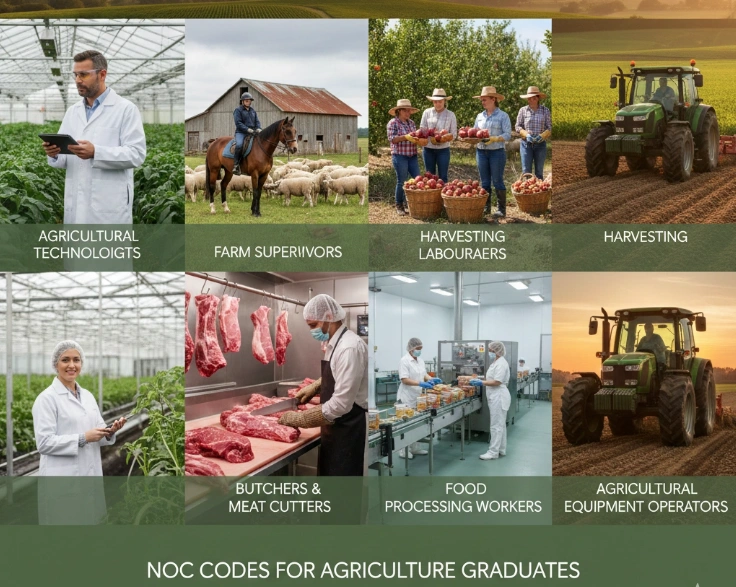
Knowing your National Occupational Classification (NOC) code is crucial when applying for PR. It identifies your skill level, job duties, and eligibility under federal or provincial programs.
Some of the most relevant NOC codes for agriculture graduates include:
- 21112 – Agricultural Technologists and Technicians
- 82030 – Farm Supervisors and Specialized Livestock Workers
- 63201 – Butchers and Meat Cutters
- 85101 – Harvesting Labourers
- 94141 – Food Processing Workers
- 85100 – Agricultural Equipment Operators
These codes fall within TEER levels 2–5, but the Agri-Food Pilot and several provincial nominee programs (PNPs) accept applications from TEER 2 and 3 as skilled experience. So, if your first job after graduation falls under one of these categories, you’re already on the right track.
Specialized PR Pathways for Agriculture Graduates
Unlike many industries where Express Entry is the only route, agriculture has dedicated PR pathways — both federal and provincial — that simplify the process.
The Agri-Food Pilot Program is the best-known federal initiative, targeting roles in meat processing, greenhouse production, and livestock operations. It aims to attract workers who want to build long-term careers in rural communities and has proven to be a fast, stable route to PR.
Provinces, too, have their own options:
- Saskatchewan’s Farm Owner and Operator Stream supports experienced individuals planning to purchase or manage farms. It’s ideal for students from agribusiness backgrounds who eventually want to run their own operation.
- Alberta’s Rural Renewal Stream helps employers in designated rural towns bring in skilled workers. A community endorsement followed by a provincial nomination can lead directly to PR.
- Manitoba’s Skilled Worker Program actively nominates professionals in the agri-sector, especially those in seed, grain, and animal production industries.
- Ontario’s Employer Job Offer: In-Demand Skills Stream includes food processing and farm-related occupations, offering PR opportunities even for mid-level positions.
Each of these pathways connects directly to Canada’s regional development strategy, meaning your agricultural skills aren’t just valuable — they’re part of a national vision.
For agriculture graduates, PNP is a better option than Express Entry alone, especially if the CRS score is not high. In 2026, agriculture is not a separate Express Entry category-based draw, so many agriculture applicants may need to compete through general draws.
PNP can be stronger because provinces like Saskatchewan, Manitoba, Alberta, Ontario, and PEI often need workers in farming, agri-business, food production, and rural labour markets.
Where the Jobs Are: Provincial Agriculture Hubs
When deciding where to study or work, it helps to understand the geographic strengths of Canadian agriculture:
- Saskatchewan and Alberta dominate in grain, cattle, and dairy farming. Graduates in livestock science or farm operations find abundant opportunities here.
- Manitoba is a leader in seed genetics and grain processing — ideal for research and technical careers.
- Ontario, home to Canada’s growing agri-tech sector, attracts those interested in food innovation, biotechnology, and sustainable production.
- Prince Edward Island (PEI) specializes in dairy and potato farming, often offering community settlement incentives for newcomers.
Every province faces a labour shortage in agriculture. Whether you prefer research labs, greenhouses, or outdoor fieldwork, employers across Canada are looking for young, educated workers with modern agricultural knowledge.
Career Prospects and Salary Outlook
Salaries in the agriculture sector vary by role, experience, and location, but most graduates earn competitive incomes compared to other essential industries.
For instance, agricultural technologists earn between CAD 55,000 and 75,000 annually, while farm supervisors average around CAD 60,000. Entry-level roles such as food processing or harvesting can start around CAD 35,000–45,000, offering steady progression to supervisory or technical positions within a few years.
What truly sets this field apart is career security. Agriculture isn’t subject to major economic downturns — people will always need food and sustainable production. As technology continues to reshape farming, roles in precision agriculture, data analytics, and sustainability management are creating entirely new career paths that didn’t exist a decade ago.
Life After PR: Benefits and Settlement Support
Once you achieve permanent residency, you’re not just allowed to stay in Canada — you gain access to an array of benefits that help you settle comfortably. These include:
- Universal healthcare through provincial health coverage.
- Free public education for your children.
- Tax benefits like the Canada Child Benefit (CCB) and GST rebates.
- Access to training programs, housing support, and community incentives, especially in rural provinces.
- The ability to apply for citizenship after three years of PR.
Several provinces also provide relocation bonuses or settlement assistance to encourage PR holders to remain in rural towns. For agriculture graduates, this means affordable living, job stability, and a welcoming environment that values your contribution to local economies.
The PR Journey: Step by Step
Here’s how most agriculture graduates transition from study to PR in Canada:
- Complete your agriculture degree or diploma from a DLI.
- Obtain your PGWP and work in an eligible NOC code.
- Gain at least one year of full-time Canadian work experience.
- Secure a valid job offer in your field (for pilot or PNP programs).
- Choose your pathway — Express Entry (CEC), Agri-Food Pilot, or a provincial stream.
- Submit your PR application with required documents (work letters, payslips, transcripts, language scores).
- Receive AOR (Acknowledgment of Receipt), complete biometrics and medicals.
- Wait for final decision and PR confirmation.
Most students who plan strategically — choosing the right program, employer, and province — achieve PR within three to five years of starting their studies.
Consultant’s Advice: Choosing the Right Province
Over years of assisting students and skilled professionals, one trend has remained consistent — location matters. The province you study and work in often determines how fast you can secure PR.
If you’re aiming for a clear and stable route, Saskatchewan remains the top recommendation. Its agriculture-focused streams are well-defined, and the province continues to expand its nomination quota annually. Manitoba offers excellent support for newcomers and prioritizes agricultural workers under its Skilled Worker Program.
Alberta immigration draw is perfect for those seeking community-based draws for agriculture stream students, while Ontario suits those looking for higher-paying roles and research-oriented careers. The key is to balance opportunity with long-term residency potential — a factor every successful PR applicant understands early.
Final Thoughts
Canada’s agricultural industry is undergoing a transformation — one that blends tradition with innovation, and local roots with global talent. As the country looks to secure its food future and strengthen rural economies, international agriculture graduates are at the heart of that vision.
Your education in Canada doesn’t just prepare you for a job; it positions you for a sustainable, respected, and permanent career. With clear immigration pathways like the Agri-Food Pilot, PGWP advantages, and provincial nominee streams, agriculture is more than a field of study — it’s a lifelong opportunity to grow, contribute, and build a home in one of the world’s most stable and welcoming countries.