Recommended Blog Posts
- 7 Important Steps Before Applying For Canada’s Parents Sponsorship Program (PGP)
- What Is COPR in Canada Immigration and What Happens After You Receive It
- IEHP Programs in Canada: Helping Foreign Doctors & Nurses Build Their Careers
- Educational Credential Assessment (ECA) - Immigration Steps for International Students
- The Ultimate CLB 9 Guide: How to Secure Your Canada PR in 2026
RCIC Expert Tips: Maximizing Your PNP Success in 2026 Through Enhancing Your CRS Score
Publish On: December 02, 2025
If you’ve been tracking Canada immigration lately, you already know this: PNP remains the most reliable pathway to Canada PR, especially for skilled workers who want a faster, more predictable route than waiting endlessly for high CRS Express Entry draws.
But here’s the part most applicants miss.
Even though the PNP route feels straightforward on paper, your chances of success depend heavily on strategy—not luck.
As RCICs (Regulated Canadian Immigration Consultants) often say:
“The PNP is not a generic, one-size-fits-all application. It’s a game of timing, targeting, and understanding what each province truly needs.”
In this blog, you’ll learn highly practical, field-tested insights used by RCICs to help applicants secure PNP nominations—especially in competitive provinces like Ontario, British Columbia, Alberta, and Saskatchewan.
Let’s break down the four most crucial RCIC-level strategies to maximize your PNP success in 2026.
1. Identify Provinces with Occupation Shortages
If you ask any experienced RCIC what determines your PNP success the most, they’ll say this:
“Your NOC must match an actual labour shortage in the province—not just what you prefer.”
Many Indian applicants make the mistake of choosing provinces randomly.
“Ontario is popular, so let me apply here.”
“My cousin is in Alberta, so I’ll choose Alberta.”
But PNPs don’t work that way.
Why Choosing Provinces with Real Shortages Matters
Each province updates its labour market needs based on:
- economic growth
- employer demand
- population gaps
- upcoming projects
- retirement trends
- healthcare and infrastructure requirements
These shortages directly influence which NOCs get:
- targeted draws
- priority processing
- extra CRS points
- nomination invitations
When your NOC appears in a province’s shortage list, your chances improve dramatically.
Examples of Province-Specific Needs (Trends RCICs observe)
While needs fluctuate monthly, there are clear patterns:
Ontario
Strong demand for:
- Tech jobs
- Healthcare workers
- Business analysts
- Finance professionals
- Engineers
British Columbia
High need for:
- Tech (Software, Cloud, DevOps)
- Retail supervisors
- Supply chain roles
- Construction trades
- Early childhood educators (ECE)
Alberta
Consistent demand for:
- Engineering occupations
- Hospitality supervisors
- Truck drivers
- Administrative roles
- Manufacturing labour
Saskatchewan & Manitoba
Focus on:
- Agriculture PR pathway
- Manufacturing
- Healthcare
- Trucking
- Skilled trades
Atlantic Canada (NS, NB, NL, PEI)
Looking for:
- Nurses
- Caregivers
- IT roles
- Early childhood educators
- Hospitality roles
How to Match Your NOC with the Right Province
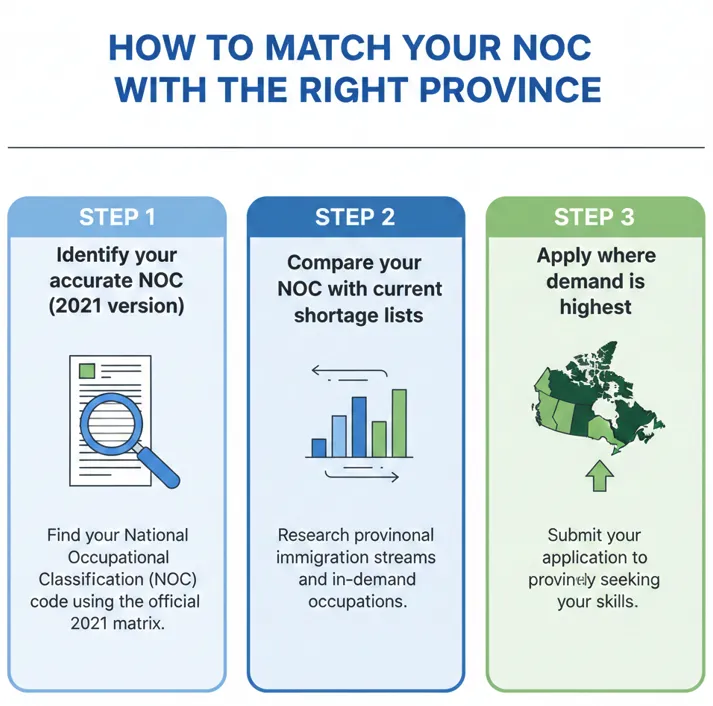
RCICs typically follow a structured process:
Step 1: Identify your accurate NOC (2021 version)
Many rejections happen simply because applicants choose the wrong NOC.
Step 2: Compare your NOC with current shortage lists
Every province releases:
- occupation-in-demand lists
- targeted category streams
- employer-driven pathways
- monthly EOI selection patterns
Step 3: Apply where demand is highest
If two provinces need your NOC, choose the one with:
- easier criteria
- faster processing
- lower cut-off
- larger nomination quotas
Why This Strategy Speeds Up Your PR Process
When your NOC is in-demand:
- Applications move faster because officers want to fill urgent shortages
- Selection criteria are more flexible
- You’re more likely to receive NOI (notification of interest)
- Provinces issue more frequent draws in those categories.
RCIC Insight
“Stop chasing provinces you like. Start choosing provinces that like your NOC.”
2. Boost CRS Through French or a Valid Job Offer
(The two biggest CRS boosters for PNP + Express Entry in 2026)
Even though PNP nomination gives you 600 CRS points, the base CRS score still plays a huge role.
Higher CRS = Better chances of receiving:
- tech draws
- category-based draws
- provincial NOIs
- employer offers
- OINP and BC PNP invitations
Two strategies work exceptionally well in 2026:
French and Job Offers.
A. Boost Your CRS Through French (TEF/TCF)
Most applicants underestimate how powerful French can be.
Even CLB 4–6 French can significantly influence:
- category-based Express Entry draws (French proficiency is now a major category)
- provinces like Ontario, Manitoba, NB, NS increasingly targeting bilingual candidates
- bonus CRS points
CRS Breakdown for French
- Up to 50 points: French-language bonus
- Additional 25–50 points: if combined with English
- PNP streams specifically targeting bilingual candidates
Why French Helps Immensely in 2026
- Canada is pushing bilingual workforce expansion
- Ontario and Manitoba issue regular draws for French speakers
- Many PNPs lower the cut-off for bilingual candidates
- Less competition = better chances
You don’t need to be fluent. Even moderate scores give huge advantages.
B. Boost Your CRS With a Valid Job Offer (LMIA or LMIA-exempt)
Another powerful strategy RCICs prioritize is securing a valid Canadian job offer.
With a valid job offer, you get:
- 50 CRS points for most NOCs
- 200 points for senior managerial NOCs
- Priority PNP draws (especially BC, Alberta, Manitoba)
- Pathway to employer-driven streams like SINP, AINP, OINP Employer Job Offer
What Makes a Job Offer “Valid”?
It must be:
✔ full-time
✔ non-seasonal
✔ from a Canadian employer
✔ for at least 1 year
✔ supported by LMIA or LMIA-exempt category
Why RCICs Push Job Offers for PNP
- Provinces prefer applicants who already have employer support
- It guarantees economic contribution
- It reduces the chances of refusal
- Many provinces reserve specific quotas for job-offer candidates
RCIC Insight
“Even 25–50 extra CRS points can shift you from invisible to in-demand.”
3. Keep Profile Updated in the Express Entry Pool
(The biggest mistake applicants make? Neglecting their Express Entry profile.)
Many candidates create an Express Entry profile once, upload documents, and forget about it.
But Express Entry is not static—it’s a competitive, evolving pool.
If your profile is outdated, you risk:
- missing targeted PNP selections
- becoming ineligible
- losing out on provincial NOIs
- CRS dropping due to missing updates
- system glitches marking your profile as incomplete
Details You MUST Keep Updated Regularly
RCICs advise updating these immediately:
Work Experience
Add new roles, promotions, or NOC changes.
Many provinces target specific experience duration (e.g., 1 year, 6 months, 2 years).
Education
If you complete:
- master’s
- diploma
- new ECA
- update it ASAP.
Language Tests (IELTS, CELPIP, TEF, TCF)
Scores expire every 2 years.
Most applications fail due to expired test scores.
Marital Status
Because spouse factors can change CRS drastically.
Proof of Funds
IRCC updates the settlement fund amounts every year.
If you don’t update, your application becomes ineligible silently.
Job Offer / LMIA
This can shift your position in the pool instantly.
Why Updated Profiles Are Essential for PNP
Provinces pick profiles based on:
- latest CRS
- updated NOC
- new French scores
- new work experience
- new tie-breaking rules
An outdated profile = missed NOI.
RCIC Insight
“Treat your Express Entry profile like your resume. Keep polishing it. Opportunities appear when your profile is active and updated.”
4. Apply Early Before Provincial Quotas Fill
(PNP streams fill up faster every year—2026 will be even tighter.)
One of the biggest misconceptions among applicants is that PNP streams stay open year-round.
They don’t.
Almost every PNP stream has:
- annual quotas
- monthly limits
- EOI category caps
- occupation-specific ceilings
Once the quota fills, provinces close the stream instantly.
Examples of Quota Closures RCICs See Regularly
- BC PNP Tech draws fill fast
- SINP Occupations-in-demand hits the cap early each year
- PEI PNP holds small, targeted draws
- Ontario’s Human Capital Priorities Stream fills in minutes after opening
This pattern will continue in 2026, especially with the increased competition.
Why Applying Early Improves Your Success
Early applicants get:
- priority processing
- better cut-offs
- more frequent invitations
- access to all quota cycles
- first consideration for targeted occupations
Late applicants get:
- longer processing times
- limited options
- higher cut-offs
- fewer NOIs
- unexpected stream closures
Think of PNP Like Train Tickets During Festive Season
You book early → Confirmed berth.
You wait → Waiting list or train full.
Same logic.
RCIC Insight
“Don’t wait for a perfect moment. Apply early when your scores are fresh, documents valid, and quotas wide open.”
Putting It All Together: Your PNP Success Formula for 2026
Here is the simplified RCIC-backed framework:
STEP 1: Choose your province based on NOC shortages
Not popularity.
STEP 2: Boost CRS through French or a job offer
Give yourself an advantage others don’t have.
STEP 3: Update your Express Entry profile regularly
Stay visible.
STEP 4: Apply early before quotas fill
Timing is everything.
Final Expert Takeaway
The Provincial Nominee Program is not about luck.
It’s about strategy—choosing the right province, building the right CRS profile, and applying at the right time.
If you follow these RCIC-level strategies, your chances of securing a PNP nomination in 2026 increase dramatically.