Recommended Blog Posts
- Canada Immigration Levels Plan 2026–2028 for Skilled Workers & International Students
- Canada’s Tech Talent Strategy (H1B Visa Update): Comprehensive Immigration Pathways for Global Innovators
- PNP & Express Entry 2026: Common Refusal Reasons, New Financial Rules, Updated Language Requirements & PR Strategies for Skilled Workers
- Canada’s Regional Migration Strategy: A Game-Changer for Newcomers in 2026
- Latest IRCC Backlog Insights 2025-26: Processing Time Trends and Predictions For Canada PR Applications
How AI Is Transforming Canada’s Visa Application System in 2026
Publish On: November 14, 2025
For decades, getting a Canadian visa meant long queues, thick files, and waiting months for an update. But 2026 marks a turning point.
The Immigration, Refugees and Citizenship Canada (IRCC) has quietly rolled out one of its biggest transformations yet — AI-assisted visa processing.
If you’ve applied for a study permit, work visa, or PR in 2026, there’s a good chance your application has already passed through an AI system before reaching a human officer.
Now, that doesn’t mean a robot is deciding your future. It means Canada is learning to use technology to make immigration smarter, faster, and fairer.
But to make sure your application thrives in this new system, you need to understand how this technology works — and how to adapt your file to fit it.
Why IRCC Uses AI (And What It Means for You)
Every year, IRCC receives millions of applications — all from people hoping to start a new life in Canada. Managing that kind of volume by hand was becoming nearly impossible.
That’s why, starting around 2024 and scaling up by 2026, IRCC integrated AI-driven systems into its visa processing chain. The goal? Not to replace officers — but to support them.
AI helps with three big challenges:
- Managing massive queues efficiently.
- Detecting incomplete or inconsistent applications.
- Speeding up decisions on straightforward, low-risk files.
In short, AI helps IRCC do the routine work — so officers can focus on the complex and human side of immigration.
Triage, Queueing, and Document Screening
When your file arrives, it’s not just sitting in a pile anymore. AI runs an instant digital triage.
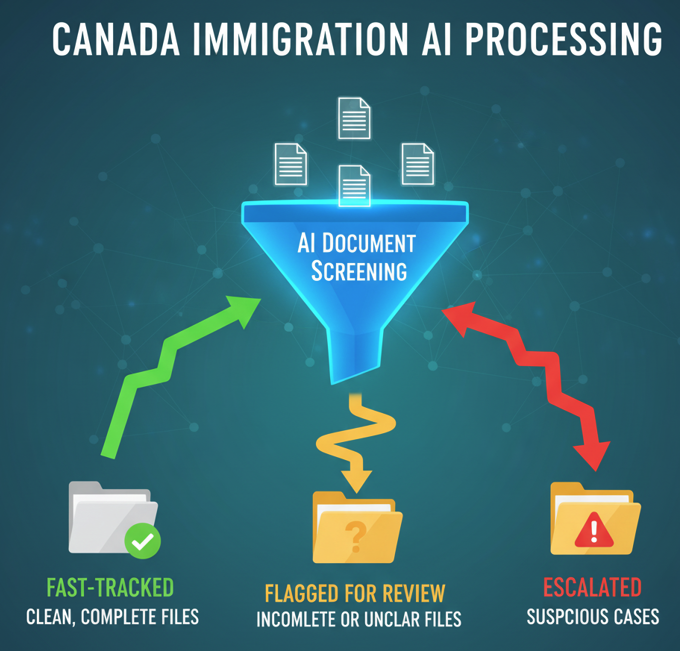
Think of it like a smart sorting system — scanning your documents for patterns, verifying consistency, and organizing applications by how ready they are for review.
- Clean, complete files are fast-tracked.
- Incomplete or unclear ones are flagged for officer review.
- Suspicious or inconsistent cases are escalated for deeper checks.
This doesn’t mean machines are judging your worth — they’re helping IRCC prioritize fairly so genuine applicants don’t get stuck waiting behind incomplete submissions.
Speed vs. Scrutiny — How Risk Tiers Work
You’ll often hear the phrase “risk-based processing” in IRCC updates. Here’s what that means in plain language.
AI assigns each file a risk tier — not based on nationality or profile, but on data quality, consistency, and verifiability.
A “low-risk” application might move quickly because everything lines up perfectly — your passport, forms, letters, and proof documents all tell the same story. If your timeline has overlaps or missing details, the system moves it into a queue for human clarification.
So yes, AI helps things move faster — but never at the cost of accuracy. Every major decision still comes from a trained officer.
It’s speed with oversight, not automation without empathy.
How AI Is Transforming the Study Permit to PR Process
Canada welcomes over 900,000 international students annually, many of whom pursue permanent residency after graduation. Artificial intelligence is now reshaping how students navigate this complex journey — from application filing to PR approval.
AI-Powered Document Review and Error Reduction
IRCC processes millions of applications yearly. AI tools now help applicants and RCICs:
- Detect missing documents before submission
- Flag inconsistencies in financial proof or enrollment letters
- Reduce refusal rates caused by avoidable errors
Studies show documentation errors account for nearly 30–40% of study permit refusals — AI-assisted checkers are directly addressing this gap.
Smarter CRS Score Planning
AI-driven immigration platforms now analyze a student's:
- Academic credentials
- Language scores (IELTS, CELPIP, TEF)
- Canadian work experience eligibility under PGWP
...to predict Express Entry CRS scores and recommend the fastest PR pathway — whether through Canadian Experience Class (CEC), a PNP stream, or a French-language draw.
Key Stat Snapshot
| Metric | Data Point |
|---|---|
| International students in Canada (2024) | 900,000+ |
| PGWP holders transitioning to PR annually | 50,000+ |
| Study permit refusal rate (2023–24) | ~40% for some source countries |
| AI-assisted application platforms available | 15+ globally |
Immigration System Embraces AI In AOR (Acknowledgement of Receipt)
IRCC officially launched its first-ever Artificial Intelligence Strategy in early 2026, aimed at cutting processing times, reducing backlogs, and strengthening program integrity — while ensuring human officers retain full authority over every final decision. For Express Entry applicants, the AOR (Acknowledgement of Receipt) is already automated, arriving instantly or within a day or two of submission.
Beyond AOR, AI now handles approximately 4 million client email inquiries annually and powers fraud detection tools that flag document anomalies and biometric inconsistencies. For applicants, this means faster acknowledgements and stricter document scrutiny — so accuracy at the time of submission matters more than ever.
What Parts of Your File AI May Touch
AI doesn’t decide if you qualify for a visa — it supports officers by flagging details and patterns. Here’s how your file interacts with the system.
Completeness Checks, Fraud Flags, Prioritization
Once uploaded, your documents pass through automated completeness checks. The system looks for:
- Missing pages or signatures.
- Mismatched names or dates.
- Duplicate or altered files.
It also scans metadata — the hidden digital data inside your PDFs — to catch tampered or suspicious submissions.
But remember: getting flagged doesn’t mean being denied. It simply alerts an officer to review your case closely.
In many ways, this makes the process fairer, because decisions are guided by data — not by arbitrary delays or subjective impressions.
Human-in-the-Loop Decisions & Appeal Pathways
IRCC has made it clear: AI never makes the final decision.
A human officer always reviews and signs off on approvals, refusals, and procedural fairness letters. The technology only assists, never replaces.
And if you ever feel your case was misunderstood or mishandled due to automation, you still have full rights to request a human re-review or appeal.
This safeguard — often called the “human-in-the-loop” principle — keeps the process transparent and accountable. You’re never at the mercy of a machine.
Applicant Advantages in an AI-First Workflow
Here’s the good news — understanding AI’s role actually gives you an advantage.
When you know how the system reads your file, you can structure your documents to be easily understood by both AI and human officers.
Structure Your File to Be Machine-Readable (Naming, Consistency)
AI tools rely on clean structure and clarity. A cluttered, inconsistent submission can confuse both systems and humans.
Keep it neat:
- Use clear file names like “Passport_JaneDoe_2026.pdf” instead of “scan_finalv3.pdf”.
- Make sure all documents are searchable PDFs, not image scans.
- Stick to one date format throughout your application.
When your file looks clean, AI systems can match it easily — helping it move through digital triage faster.
Evidence Quality: Verifiability > Volume
Submitting 50 attachments doesn’t impress the system — or the officer.
AI tools are trained to detect verifiable information, not sheer volume. That means:
- Fewer, stronger documents are better than too many repetitive ones.
- Reference letters should have real contact info and consistent job titles.
- Links to official company websites or academic portals boost credibility.
The more traceable your evidence, the easier it is for the system to verify your story — and the faster it moves forward.
Avoiding Triggers (Mismatches, Unclear Timelines)
Most AI flags happen not because of fraud, but simple inconsistencies.
For example:
- Different job start dates between your résumé and reference letter.
- Overlapping study and work periods.
- Typos in employer names or addresses.
Before submitting, double-check every timeline across all your documents. Even a small mismatch can push your file into a longer review queue.
Remember — AI loves patterns. The more clear and consistent your story, the smoother your journey.
Ethics, Bias & Transparency
Of course, using AI in immigration raises big questions: Can algorithms be fair? Can data make mistakes?
IRCC knows this, and in 2026 it’s actively addressing these concerns through ethics-first design and public transparency.
Safeguards, Public Guidance, Complaint Channels
IRCC now operates under an official Algorithmic Impact Assessment framework. This means:
- Every AI tool used in processing must go through bias testing.
- Regular audits ensure the technology doesn’t favor or disadvantage any nationality, gender, or language group.
- A human override is always built in.
If you believe your file was mishandled, IRCC also provides complaint and re-evaluation channels. This system is far from perfect — but it’s becoming more transparent each year.
What IRCC States vs. Common Myths
There’s still a lot of misunderstanding about how AI actually works inside IRCC. Let’s clear a few myths:
| Myth | Reality (as of 2026) |
|---|---|
| “AI decides who gets approved.” | AI only supports officers — humans make the final call. |
| “You can trick the AI with keywords.” | Systems focus on structure and data accuracy, not buzzwords. |
| “AI favors some countries over others.” | All models are bias-tested and reviewed by independent auditors. |
| “AI rejections are automatic.” | Every refusal must cite human-reviewed reasons under Canadian law. |
By separating fact from fiction, applicants can focus on what really matters — accuracy, honesty, and clarity.
Practical Checklist: Making Your File AI-Ready
If you’re applying for any Canadian visa in 2026, here’s your quick, practical checklist to align with IRCC’s digital systems.
Clean Docs, Data Consistency, Cross-References
- All documents are named clearly and consistently.
- Dates match across your résumé, letters, and forms.
- Employer details are verifiable and consistent.
- Scanned files are searchable, not blurry images.
- No overlapping timelines between study, work, or travel.
These steps may seem small — but together, they help your application glide through digital triage smoothly.
Timeline Map & Version Control
Create a simple timeline spreadsheet before uploading anything.
- List every education and work period in order.
- Keep track of document versions (e.g., “Resume_2025Final.pdf”).
- Store all files in one organized folder.
If an officer or system ever questions your dates, you can quickly refer back — saving valuable time.
The Bottom Line: Adapting to Canada’s New Digital Reality
Artificial Intelligence is quietly changing the heart of Canada’s immigration system — not by removing the human touch, but by enhancing it.
For applicants, this shift means faster timelines and more predictable outcomes — if your documents are accurate, clean, and verifiable.
AI rewards clarity.
Humans reward honesty.
Together, they create a system that values transparency, truth, and trust.
So as you prepare your next visa or PR file in 2026, remember this:
AI might scan your application first, but a real person will decide your future.
Make it easy for both to say “yes.”