Recommended Blog Posts
- Canada PR with Low CRS Score: Updated Express Entry Occupation List 2026
- French Language Proficiency Express Entry Draws 2026: Latest ITAs, Targets & Top Occupations
- Healthcare & Social Services Occupations: Latest Express Entry Draws Results (2026)
- Is IELTS 7.5 a Good Score in 2026? Band Score Meaning Explained
- Express Entry Draw For Senior Managers: CRS Score, Invitations & Selection Trends
How to Calculate CRS Score for Express Entry 2026 – Canada PR Points Calculator Guide
Publish On: November 27, 2025
If you’re planning to apply for Canadian Permanent Residency through Express Entry, your CRS score (Comprehensive Ranking System) decides your chances of getting an Invitation to Apply (ITA).
But here’s the catch: CRS calculation is not just about adding numbers—it’s about understanding how IRCC awards points for age, education, language skills, work experience, and additional factors.
- What is CRS and why it matters
- Factors affecting your CRS score
- How to calculate your CRS score (with example)
- Tips to improve your score
- Why consulting a licensed RCIC can make a difference
What is the CRS Score in Express Entry?
The Comprehensive Ranking System (CRS) is a points-based system used by IRCC to rank candidates in the Express Entry pool. Every draw, IRCC sets a CRS cut-off score, and candidates with scores equal to or above the cut-off receive an Invitation to Apply (ITA) for permanent residence.
Current trend: Recent draws have had cut-offs ranging from 480+ points, which means every point matters!
CRS Score Factors – How Points Are Awarded
Your CRS score is based on four major sections:
Core/Human Capital Factors (Maximum: 460–500 points)
- Age: Maximum points for ages 20–29
- Education: Higher education = higher points
- Language Proficiency: IELTS or CELPIP results matter a lot
- Canadian Work Experience: Extra advantage for those working in Canada
- Skill Transferability Factors (Maximum: 100 points)
Combination of education, work experience, and language proficiency .
- Spouse/Common-law Partner Factors (if applicable)
Your partner’s language, education, and Canadian experience can add points
- Additional Points (Maximum: 600 points)
- Provincial Nomination = +600 points
- Job Offer = +50 or +200 points
- Sibling in Canada = +15 points
- French language skills = +25 to +50 points
Note: IRCC updated the Express Entry rule so that candidates no longer receive 50 or 200 CRS points for holding a job offer with a positive LMIA. This applies to all current and future profiles in the pool.
CRS Score Breakdown
The Express Entry system uses the Comprehensive Ranking System (CRS) to evaluate candidates. Following are the factors shown in the image, as the CRS score is the key to receiving an invitation to apply for permanent residence.
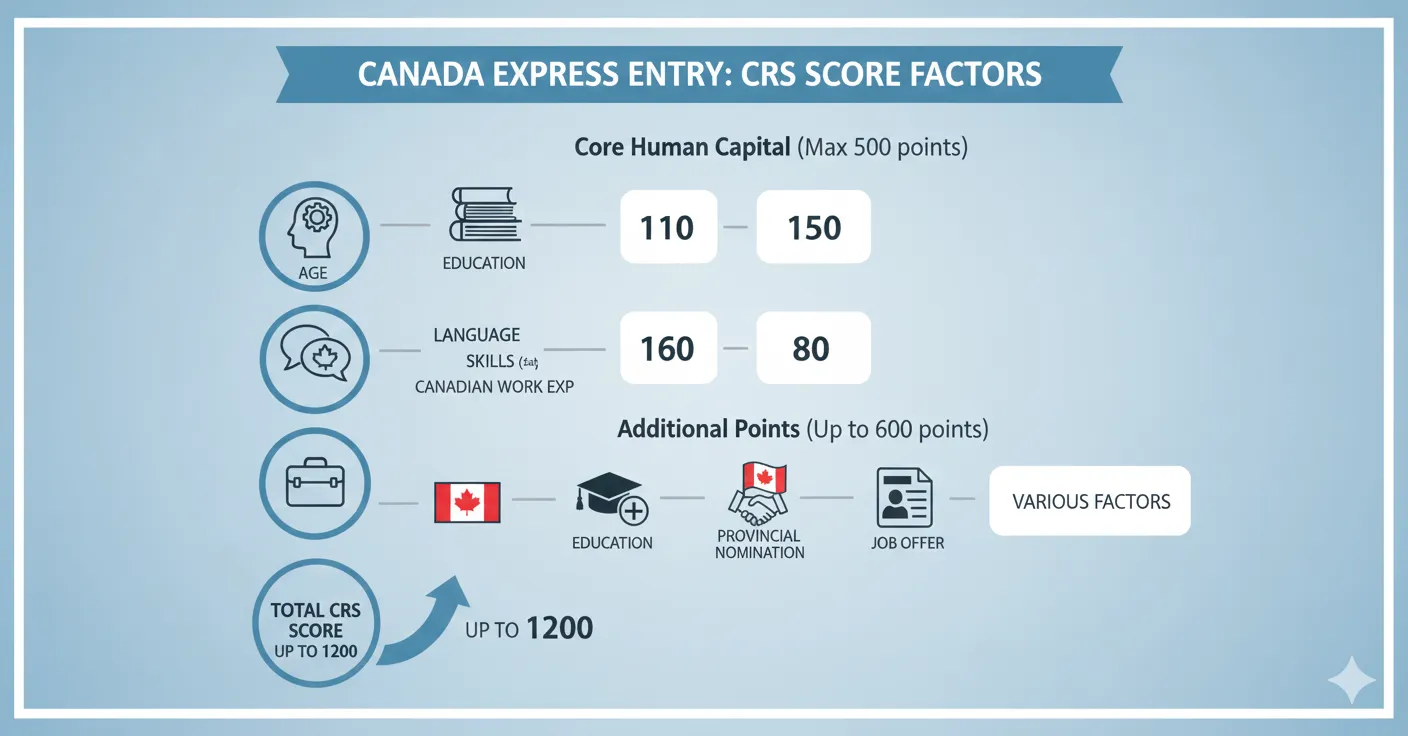
Here’s a quick breakdown of how CRS points are calculated under Express Entry:
Core Human Capital (Max 500 Points)
These factors come from your personal profile.
- Age: Highest points in your 20s; points gradually drop after 30.
- Education: Higher education levels (Master’s/PhD) earn more points. ECA or Canadian education is required.
- Language Skills: Strong IELTS/CELPIP or TEF/TCF scores in all four abilities can significantly raise your score.
- Canadian Work Experience: Skilled experience in Canada adds valuable points.
Additional Points (Up to 600 Points)
These can greatly boost your overall score.
- Provincial Nomination: +600 points — almost guaranteed ITA.
- Job Offer: Up to 200 points (most receive 50; senior roles get 200).
- Canadian Education: Completing a program in Canada can earn 15–30 extra points.
- French Language Skills: High French scores add bonus points.
- Sibling in Canada: Extra points if your sibling is a PR or citizen.
Total CRS Score (Up to 1,200)
Your final CRS score is the sum of all factors. Immigration draws invite candidates above specific cut-offs, so improving language scores, gaining Canadian experience , or securing a PNP can significantly increase your chances of receiving an ITA.
How to Calculate Your CRS Score : Case Study
Example Profile: Ravi, a 29-year-old applicant with:
- Master’s degree
- 3 years foreign work experience
- IELTS CLB 9
- No Canadian work experience
- Single applicant
Step 1: Core Human Capital Points
- Age (29 years) = 110 points
- Education (Master’s) = 135 points
- Language (CLB 9) = 124 points
- Canadian experience = 0
- Subtotal: 369 points
Step 2: Skill Transferability Points
- Education + Language = 50 points
- Foreign work experience + Language = 50 points
- Subtotal: 100 points
Step 3: Additional Points
- None (No job offer, no nomination) = 0 points
Total CRS Score = 369 + 100 = 469 points
Result: Ravi is competitive for Express Entry but might still need improvement if the cut-off goes above 470+.
CRS Score Improvement Tips from an RCIC
Your CRS score is calculated based on your age, education, language test results, and work experience, with additional points for factors like provincial nomination or Canadian education. If your score is below the cut-off, here are proven strategies to boost it:
- Improve your IELTS score – Even 1 extra CLB level can add up to 60 points
- Learn French – Adds up to 50 points
- Get a Provincial Nomination (PNP) – Adds 600 points instantly
- Canadian Job Offer – Adds 50 or 200 points
- Spousal factors – If married, improve your partner’s IELTS score
Why You Should NOT Rely Only on Online Calculators
Most online CRS calculators give approximate scores and do not account for:
- Complex profiles (multiple education credentials, foreign and Canadian experience)
- Changes in IRCC rules
- Potential for additional points through strategy
That’s where an RCIC (Regulated Canadian Immigration Consultant) comes in. Our RCIC, Mr. Satnam Kahlon, provided expert guidance to Tanveer Singh Sidhu and Kaira Martin on their successful Canada PR pathways.
Conclusion
At K7 Immigration, we offer a detailed CRS evaluation and personalized Express Entry strategy.
- Get your CRS score calculated accurately
- Find hidden opportunities to boost your score
- Receive expert advice from a licensed RCIC