Recommended Blog Posts
Do IT Professionals Still Need a High CRS Score? The New Category-Based Draws 2026 Explained
Publish On: November 25, 2025
If you're a tech professional in the United States, you're likely living in a state of frustrating uncertainty. You're watching your H-1B visa clock tick down. You've glanced at the U.S. Green Card backlog and seen a wait time that spans decades, not years.
So, you looked north to Canada's Express Entry system, the "gold standard" of skills-based immigration. And then, you hit the same wall.
You saw the latest "General" draw results and your stomach sank. The Comprehensive Ranking System (CRS) scores have been astronomically high, often demanding 520, 530, or even more. You did the math—even with a Master's degree, perfect English, and solid U.S. work experience, you're landing somewhere in the 480s or 490s.
It feels like you're stuck in the "CRS-limbo," too high to be hopeless but too low to be invited.
We're here to tell you one of the most important things you'll read in your immigration journey: You are looking at the wrong number.
Relying on "General" draw scores is the old way. In this new era of Canadian immigration, your profession is now just as valuable as your points. The high CRS score is no longer the only barrier to entry, and for you, it may not be a barrier at all.
Welcome to the world of Category-Based Draws.
A Tale of Two Systems: General vs. Category-Based Draws
First, you must understand that the Express Entry pool is no longer one giant swimming pool. IRCC now has two ways to invite candidates:
- General Draws (The Old Way): This is the "best-of-the-best" draw. It invites candidates from all programs (FSW, CEC, FST) based only on their CRS score, from highest to lowest. This is why scores have been so high—it's a pure numbers game.
- Category-Based Draws (The New, Smart Way): This is the strategic-targeting draw. IRCC ignores the top-scoring candidates and instead invites people who have a specific, in-demand skill or attribute, even if their score is lower.
The six categories IRCC is prioritizing are:
- French-language proficiency
- Healthcare occupations
- Agriculture and agri-food occupations
- Trade occupations
- Transport occupations
- And the most important one for you: STEM Occupations
Data Snapshot: Why This Changes Everything
Just having an Express Entry profile doesn’t guarantee permanent residency — you need to know how to calculate and strengthen your CRS score.
Let's look at the data from the last few months. This is why your 490 CRS score is suddenly so valuable.
| Draw Type | Date (Simulated 2025) | Minimum CRS Score | Who Was Invited? |
|---|---|---|---|
| General Draw | Oct 2, 2025 | 521 | Anyone above this score |
| STEM Category Draw | Oct 20, 2025 | 485 | Only candidates in a specific STEM job |
| General Draw | Nov 5, 2025 | 524 | Anyone above this score |
| STEM Category Draw | Nov 12, 2025 | 488 | Only candidates in a specific STEM job |
Analysis: Look at that difference. On November 5th, a Software Developer with a 523 CRS score was not invited. But on November 12th, a Software Developer with a 488 CRS score was invited.
The candidate with the lower score won because they were in the right category. Your "490-something" score didn't just become competitive; it became ideal.
The STEM Category: Are You on the VIP List?
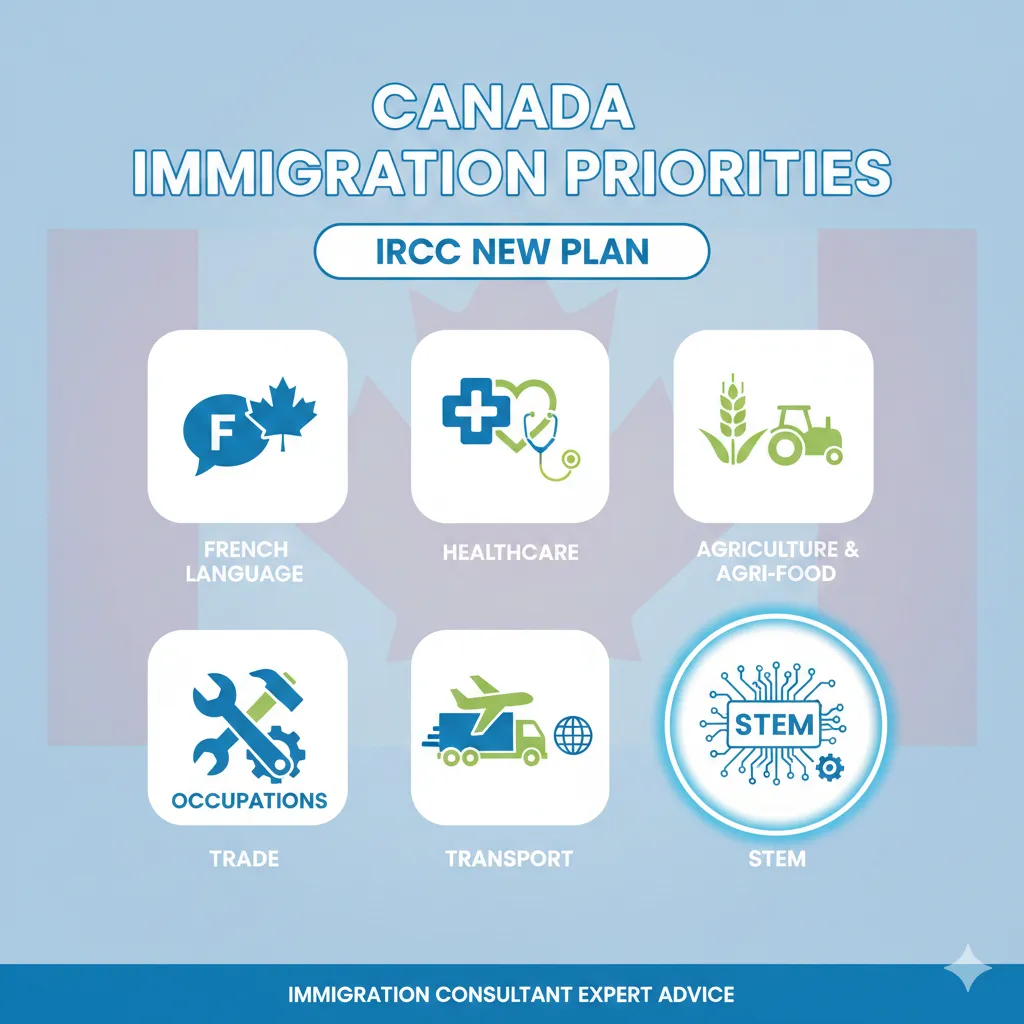
This isn't just a vague "IT sector" category. IRCC has published a very specific list of National Occupational Classification (NOC) codes that are included. If your U.S. work experience (or any skilled experience) falls under one of these codes, you are eligible for these targeted draws.
Here are some of the most in-demand STEM occupations on the list:
- Software & Data:
- Software developers and programmers (NOC 21232)
- Data scientists (NOC 21211)
- Database analysts and data administrators (NOC 21223)
- Software engineers and designers (NOC 21231)
- IT & Infrastructure:
- Cybersecurity specialists (NOC 21220)
- Information systems security professionals (NOC 21220)
- Computer and information systems managers (NOC 21311)
- Web developers and programmers (NOC 21234)
- Engineering & Other:
- Civil Engineers (NOC 21300)
- Computer engineers (NOC 21311)
- Architects (NOC 21200)
- Land surveyors (NOC 21203)
What this means: Your first and most critical step is not to just calculate your CRS score. It is to correctly identify your NOC code. A small mistake here—classifying yourself as an "IT Project Manager" when you're really a "Software Engineer"—could be the difference between getting an invitation and being left in the pool.
The CRS Mountain: Why Category Draws Were Created
Let's visualize the problem. The Express Entry pool right now is like a giant mountain. The "peak" (the highest scores) is crowded, but the largest group of skilled candidates—the "basecamp"—is sitting just below.
Express Entry Pool Distribution (As of November 2025)
As you can see, there are tens of thousands of highly qualified candidates (like you) stuck in the 470–490 range. A General Draw will never reach you because it has to clear the 500+ backlog first.
Category-based draws allow IRCC to use a "helicopter" to bypass this mountain, fly down to the 480-level "basecamp," and hand-pick all the tech professionals it needs.
Your Other Secret Weapons: Beyond the STEM Draw
As a tech professional in the U.S., you have even more pathways than just the STEM category. These are your "secret weapons."
1. The Provincial Nominee Program (PNP)
This is, without a doubt, the most powerful tool. Provincial programs are your "Plan B" and "Plan C."
- Ontario (OINP): Runs its "Human Capital Priorities" stream, which frequently holds tech-specific draws. They scan the Express Entry pool and invite tech workers, often with CRS scores in the 470s.
- British Columbia (BC PNP): Runs its "BC PNP Tech" stream, which provides a fast-track pathway for tech workers who have a job offer from a B.C. employer.
- Alberta (AAIP): Has an "Accelerated Tech Pathway" for candidates with a tech job offer, which can lead to nomination in as little as two weeks.
The Golden Ticket: If you get a nomination from any of these provinces, you receive 600 additional CRS points, which guarantees an Invitation to Apply in the next draw.
2. Canada's H-1B Holder Streams (The U.S. Advantage)
Canada knows you're in the U.S. and actively wants to attract you. In 2023, IRCC launched a pilot "H-1B Holder Open Work Permit" stream. It was so popular that the 10,000-person cap was filled in 48 hours.
While that specific pilot was closed, it proved Canada's intent. Now, they have rolled this concept into new policies:
- The Digital Nomad Stream: This allows you to come to Canada for up to 6 months while working remotely for your U.S. employer.
- The "Foot-in-the-Door" Strategy: Here's the new pro-move: Come to Canada on the Digital Nomad stream. While you're here, you can network and secure a job offer from a Canadian employer. Once you have that Canadian job offer, you can apply for a traditional work permit from inside Canada. You've just bypassed the entire LMIA process and can now gain Canadian work experience, which rockets your CRS score.
The Verdict: So, Does Your CRS Score Still Matter?
Yes, absolutely. But how it matters has completely changed.
Your CRS score is no longer a "pass/fail" number for getting into Canada. It is now a "qualifying threshold" to compete within your category.
- The Old Way: You had to beat everyone (doctors, lawyers, bankers) in a race to 520+ points.
- The New Way: You only have to beat other tech professionals in a race to a much more achievable score, like 485.
Your NOC code (your profession) is now just as important, if not more important, than your raw CRS score.
Your New 3-Step Strategy
As Regulated Canadian Immigration Consultants, here is the strategic advice we now give to all our U.S.-based tech clients.
- Identify Your NOC: First, we must perfectly align your U.S. work experience with an in-demand Canadian NOC code. This is the foundation of your entire strategy.
- Get in the Pool (No Matter What): Get your ECA, take your IELTS or CELPIP test, and get a "good" score (aim for 480+). This makes you eligible for both STEM category draws and PNP-tech draws.
- Run Parallel Paths: Don't just sit in the pool. Actively pursue PNPs. Look at job offers in B.C. and Alberta. Be ready to move when a tech draw is announced.
Your U.S. tech experience is one of the most valuable assets you have in the world of immigration. Don't let a high "General" CRS score discourage you. You're not stuck at the bottom of the list; you're just waiting in the "VIP" line.