Recommended Blog Posts
- BC PNP Entrepreneur Immigration 2026: 7 Reasons First-Time Applications Can Fail Even When You Meet the Minimum Requirements
- Why U.S. Tech and Healthcare Workers Are Looking at British Columbia | BC PNP Latest Draw Results
- BC PNP Skills Immigration vs Express Entry BC: Key Differences, Processing Times and Which Route Is Faster in 2026
BC PNP for Healthcare Workers Leaving the UAE and India: Credential Recognition Reality Before You Apply
Publish On: August 18, 2026
British Columbia wants more healthcare professionals. British Columbia's current BC PNP strategy strongly prioritizes the care economy. Yet the province still requires applicants to meet the qualifications, registration, licensing and professional-certification requirements of the job they have been offered.
For internationally trained healthcare professionals, there are really two separate processes:
Professional recognition → permission to practise in British Columbia and
Immigration → permission to work and eventually live permanently in Canada
The two processes interact, but they are not interchangeable.
This distinction matters particularly for healthcare professionals moving from India or the UAE, where applicants may have excellent clinical experience but discover that their Canadian immigration strategy depends on how far they have progressed with B.C. licensing.
Why B.C. Is Recruiting Healthcare Workers
| B.C. healthcare indicator | Latest official projection/data |
|---|---|
| Health care & social assistance industry openings, 2025–2035 | 199,200 |
| Health occupations specifically, 2025–2035 | 116,300 |
| Registered nurse/RPN openings | 28,440 |
| Nurse aide/orderly/patient service openings | 22,990 |
| Family physician openings | 4,740 |
| Physiotherapist openings | 2,720 |
| Medical laboratory technologist openings | 1,840 |
| Healthcare-targeted BC PNP invitations, Aug. 6, 2026 | 124 |
| Minimum score in Aug. 6 healthcare selection | 84 |
| Potential IEN bursary support | Up to CAD $17,000 |
B.C.'s latest Labour Market Outlook projects approximately 199,200 openings in the health care and social assistance industry from 2025 to 2035, representing 19% of all expected provincial job openings. Looking specifically at occupations classified under health, B.C. expects approximately 116,300 openings—58,200 from expansion and 58,100 from replacement demand.
The demand is real. The question for a foreign-trained professional is whether they can become professionally employable in B.C., not simply whether their occupation appears on an immigration list.
Is There a BC PNP Pathway Specifically for Healthcare Workers?
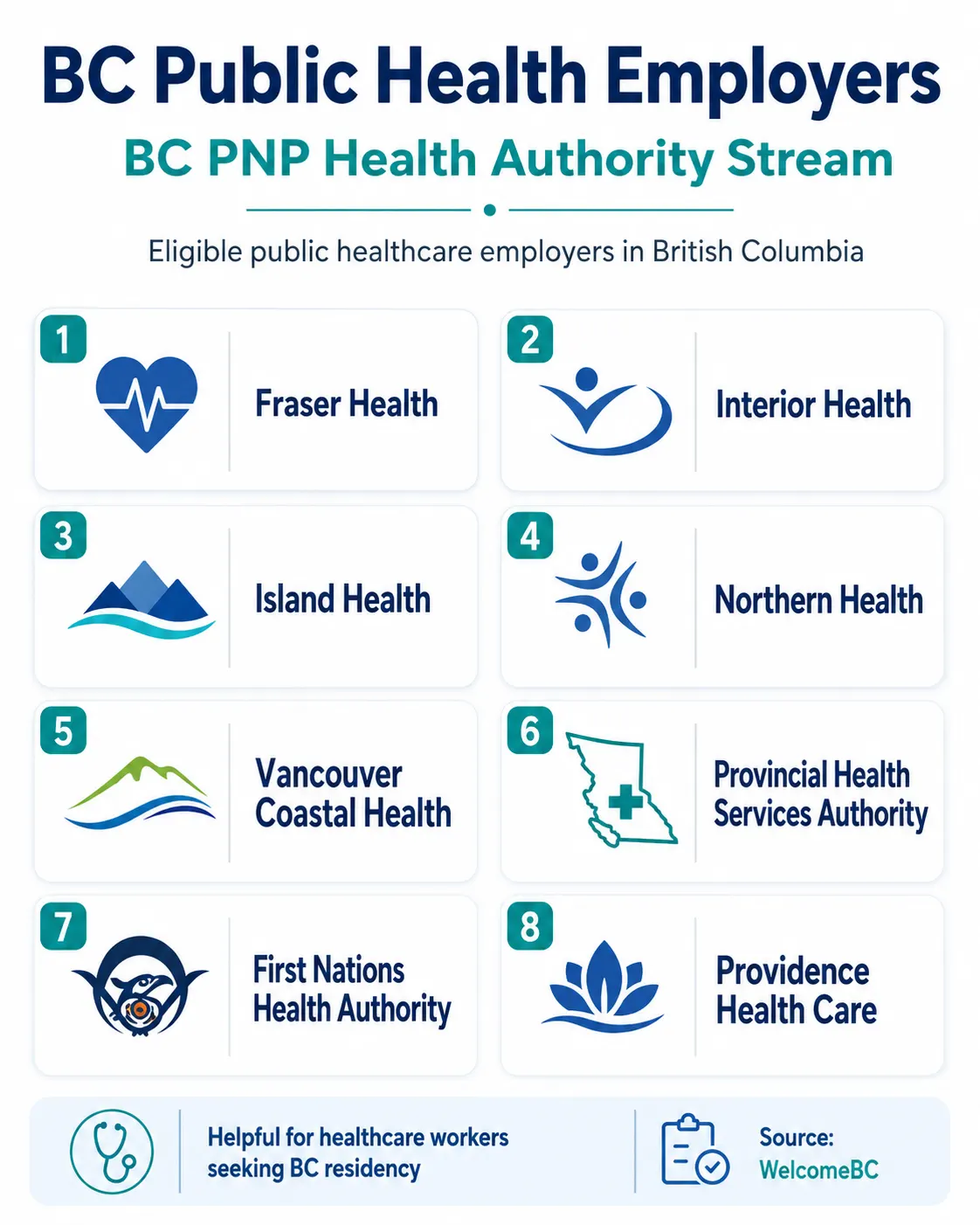
Yes. The BC PNP Health Authority Stream is particularly important for professionals joining B.C.'s public healthcare system.
A direct employee generally needs:
- a regular, full-time job;
- an indeterminate job offer;
- employment in an eligible healthcare occupation;
- support from a B.C. public health authority;
- the education and professional qualifications required for the position; and
- the applicable BC PNP language and other general requirements.
One major advantage is that qualified Health Authority Stream candidates do not need to submit a BC PNP registration and wait for a provincial invitation. Once the requirements are satisfied and the health authority supports the case, the applicant can apply directly to the BC PNP.
Physicians, nurse practitioners and midwives have some special rules because they are not always conventional salaried employees. Physicians and nurse practitioners, for example, may qualify with health-authority support if they are licensed—or eligible to be licensed—to practise their profession in B.C.
Healthcare Workers Outside the Public Health Authorities Have Another Route
Not every healthcare worker will be hired directly by a provincial health authority.
A physiotherapist working for a private rehabilitation clinic, a pharmacist employed by a community pharmacy or another healthcare professional working for an eligible private employer may instead need to qualify through the BC PNP Skilled Worker Stream.
That route generally requires:
- an eligible B.C. job offer;
- employer support;
- the required professional qualifications;
- at least two years of qualifying full-time-equivalent work experience;
- applicable language requirements; and
- selection through B.C.'s registration and invitation system.
Healthcare remains one of B.C.'s current Care priorities. On August 6, 2026, the province issued 124 healthcare-targeted invitations with a minimum BC PNP registration score of 84.
This is useful for workers outside the Health Authority Stream—but it should not be confused with automatic selection simply because someone is a nurse, pharmacist or therapist.
Credential Recognition by Healthcare Profession
| Profession | Main Canadian/B.C. body | Reality for India/UAE-trained applicants |
|---|---|---|
| Registered Nurse / LPN / RPN | BCCNM + Inspire Global Assessments | Education, practice, language and competency may be assessed; additional education may be required |
| Physician | College of Physicians and Surgeons of B.C. | International training must fit an eligible B.C. licensing pathway; India/UAE are not automatically covered by the new select-jurisdiction route |
| Pharmacist | PEBC + College of Pharmacists of B.C. | Document evaluation, examinations and B.C. registration requirements apply |
| Physiotherapist | CAPR + B.C. regulator | International credentials are assessed before examination/licensing |
| Occupational Therapist | ACOTRO + CHCPBC | Must complete the substantial-equivalency process before B.C. licensing |
| Medical Laboratory Technologist | National credential/certification process plus applicable B.C. requirements | Overseas education is assessed against Canadian competency standards |
| Health Care Assistant | BC Care Aide & Community Health Worker Registry | Registry status is particularly important for NOC 33102 candidates |
Nurses From India and the UAE: Expect an Assessment, Not Automatic Equivalency
British Columbia's nursing regulator is the BC College of Nurses and Midwives (BCCNM).
Most internationally educated applicants work through BCCNM and Inspire Global Assessments. The process can examine:
- identity;
- education credentials;
- English-language proficiency;
- previous nursing registration;
- employment history;
- current clinical competency; and
- whether additional education is required.
BCCNM says most internationally educated nurses are assessed for both LPN and RN registration through the same application process. Depending on the assessment, an applicant may need transitional coursework or a more substantial bridging/re-entry program. RN candidates ultimately need to meet regulatory examination requirements such as the NCLEX-RN.
There is also an important country-specific reality.
B.C. has expedited RN licensing pathways for certain applicants educated and practising in places such as the United Kingdom, Australia, New Zealand and the United States. India and the UAE are not part of those expedited education pathways simply because an applicant currently works there.
A practical advantage for nurses
Eligible internationally educated nurses choosing B.C. may access provincial financial support of up to approximately CAD $17,000, depending on the assessment and education required.
Funding can help with:
- credential assessment;
- English testing;
- BCCNM fees;
- Inspire assessment;
- transitional education; and
- some travel expenses.
The support normally comes with eligibility conditions and a return-of-service commitment.
For an Indian nurse currently working in the UAE, this can materially change the cost of becoming licensed—but the bursary does not remove the professional assessment itself.
Physicians: The 2026 Licensing Change Does Not Automatically Include India or the UAE
British Columbia expanded licensing options for certain internationally trained physicians in July 2026.
The College of Physicians and Surgeons of B.C. introduced changes allowing physicians trained in selected jurisdictions to potentially qualify for full licensure if they meet the required conditions.
Those specified jurisdictions include:
Australia, Hong Kong, Ireland, New Zealand, South Africa, Switzerland and the United Kingdom.
India and the UAE are not currently on that specific list.
This does not mean an Indian physician or a doctor practising in the UAE cannot work in British Columbia.
It means they should not assume the new select-jurisdiction pathway applies to them.
Their route will depend on factors such as:
-
country of postgraduate training;
-
specialty or family-medicine credentials;
-
examination history;
-
independent-practice experience;
-
clinical currency;
-
the licence class for which they qualify; and
-
potential recruitment or practice-ready pathways.
For physicians, professional licensing should therefore be investigated before treating BC PNP eligibility as the primary problem.
Pharmacists: A Major Change Is Coming in 2027
International pharmacy graduates have a separate process involving the Pharmacy Examining Board of Canada (PEBC) and the College of Pharmacists of British Columbia.
Current B.C. requirements for international graduates include steps involving credential/document evaluation, professional examinations, English-language proficiency, jurisprudence, structured practical training and provincial licensing requirements.
There is an important upcoming change.
Beginning in January 2027, PEBC will remove the Pharmacist Evaluating Examination as a mandatory stage for international pharmacy graduates. Eligible applicants will instead proceed from successful document evaluation toward Part I of the Pharmacist Qualifying Examination. The October 2026 Evaluating Examination is the final scheduled administration.
That change simplifies one stage—but it does not mean an Indian or UAE pharmacy qualification automatically becomes a Canadian pharmacist licence.
Document evaluation, qualifying examinations and B.C.'s provincial licensing process still remain.
Physiotherapists: Credential Rules Are Also Changing in 2026
B.C. expects approximately 2,720 physiotherapist openings between 2025 and 2035, and WorkBC specifically notes that the province relies on professionals trained outside B.C. and Canada to help meet demand.
Internationally educated physiotherapists first deal with the Canadian Alliance of Physiotherapy Regulators (CAPR).
A new Comparability Pathway is scheduled to launch in October 2026. It is intended to modernize the assessment of international physiotherapy qualifications before applicants proceed toward the Canadian Physiotherapy Examination and provincial registration.
This is another reason older immigration blogs can be misleading: the credential-recognition process itself is changing even when the BC PNP occupation remains eligible.
Occupational Therapists Have Their Own Assessment Route
Internationally educated occupational therapists generally cannot move directly from a foreign OT licence into B.C. practice.
They first work through the Association of Canadian Occupational Therapy Regulatory Organizations (ACOTRO) and its Substantial Equivalency Assessment System before applying to B.C.'s College of Health and Care Professionals.
The B.C. regulator explicitly states that internationally educated occupational therapists must complete the SEAS process before applying for B.C. licensure.
This demonstrates why a generic “healthcare credential assessment” is not enough. Every profession has its own regulatory sequence.
Immigration Language Score and Professional Language Requirement Are Not the Same Thing
Another mistake is assuming that meeting the BC PNP language threshold settles the licensing issue.
The BC PNP's general minimum under its current worker streams is CLB 4, subject to stream and occupation-specific conditions.
Professional regulators can impose different English-language requirements.
B.C.'s internationally educated allied-health guidance specifically warns that the English test required for professional credential assessment may not be the same test used for immigration purposes.
So an applicant can theoretically satisfy an immigration language requirement and still be unable to complete professional licensing.
Treat the two tests as separate checklists.
Does a Healthcare Occupation Automatically Get a BC PNP Invitation?
No.
This needs to be stated clearly.
B.C. currently includes a substantial list of healthcare occupations within its Care selection priority, including physicians, pharmacists, physiotherapists, occupational therapists, nurses, LPNs, respiratory therapists, medical laboratory technologists, sonographers and social workers.
But being on the list does not by itself generate an invitation.
For candidates using the Skilled Worker route, B.C. can consider factors such as:
-
occupation;
-
professional designation;
-
language ability;
-
work experience;
-
wage;
-
location of employment;
-
education; and
-
provincial strategic priorities.
B.C. had 8,306 registrations in its Skills Immigration pool as of August 4, 2026, illustrating that candidates still compete for limited nominations.
The Health Authority Stream is different because eligible candidates supported by a public health authority can apply directly rather than entering the registration pool.
Does UAE Experience Help With BC PNP?
Yes, legitimate paid UAE work experience can be valuable.
It can help establish:
-
professional currency;
-
directly related work experience;
-
employer confidence;
-
specialization;
-
management experience; and
-
immigration work-experience eligibility.
But it should be understood correctly.
UAE experience can strengthen your profile. It does not replace Canadian professional recognition.
A five-year ICU nurse from Abu Dhabi may be highly attractive to an employer, but that nurse still needs to satisfy B.C.'s nursing regulator before independently practising as an RN.
Does an Indian Healthcare Degree Need a Canadian ECA?
Sometimes—but an immigration ECA and professional credential assessment are not necessarily the same thing.
An Educational Credential Assessment used for immigration asks broadly:
What is this foreign education equivalent to in Canada?
A professional regulator asks a much more specific question:
Does this education, training and competency meet the standard required to safely practise this regulated health profession?
Receiving an immigration ECA that says your foreign degree is equivalent to a Canadian bachelor's degree does not automatically qualify you as a nurse, physiotherapist, pharmacist or physician in B.C.
This distinction is one of the most important things foreign healthcare applicants should understand.
Final Takeaway: Don't Start With PR—Start With Employability
For an Indian nurse working in Dubai, an Indian physician practising in Abu Dhabi, or an internationally trained pharmacist or physiotherapist, that difference can determine whether the move takes a few organized steps—or becomes a long cycle of applications, rejected jobs and unexpected credential requirements.
Before calculating BC PNP points, determine whether British Columbia recognizes you as ready—or on a clear path to being ready—to perform the healthcare job you intend to use for immigration.
That is the credential-recognition reality worth understanding before you apply.